Showing posts with label travel. Show all posts

Saturday, April 23, 2011

So you want to climb a volcano

I have been busy at work recently, but I also realize that my time in Panama will be quickly coming to an end. There is a lot of travel I still want to do, several destinations left on my Panama bucket list. I got to cross one of them off this weekend, as I climbed Panama's highest peak, Volcan Baru Thursday night with several friends.

We made it to the trailhead in Boquete and started hiking around 10p.m. I packed light, with a Camelbak holding only my water, snacks and several layers to stay warm as the temperatures dropped. I was a little nervous, as I had heard several horror stories from another PCV- involving hikers who turned around, threw up, cried, or even had trail side "bathroom accidents" as their bodies gave way to fatigue. I wondered if it was the best activity to undertake after 10 hours days of heavy construction and cement mixing. But, two hours in, although I felt the burn, I knew he'd overstated the difficulty. I'd be fine. Our headlamps guided us and conversation made the time pass quickly. Every now and then we stopped to refuel on peanuts, granola bars or fruit and keep ourselves hydrated. As we climbed higher, we covered our tanks and tees with long sleeves and sweatshirts. I love being cold in Panama.

The last hill was the most costly, I wove my way up it, feeling slightly dizzy from the altitude and/or five and a half hours of strenuous hiking. If we made a mistake, it was leaving as early as we did. We thought it might take longer to get there, but our 3:30 a.m. arrival made for a long wait until sunrise. Temperatures were in the 40s but felt much colder with blowing winds and sweaty bodies that were cooling down too fast. We huddled together trying to keep as warm as possible and looking for buildings to sneak into on a compound just below the peak.

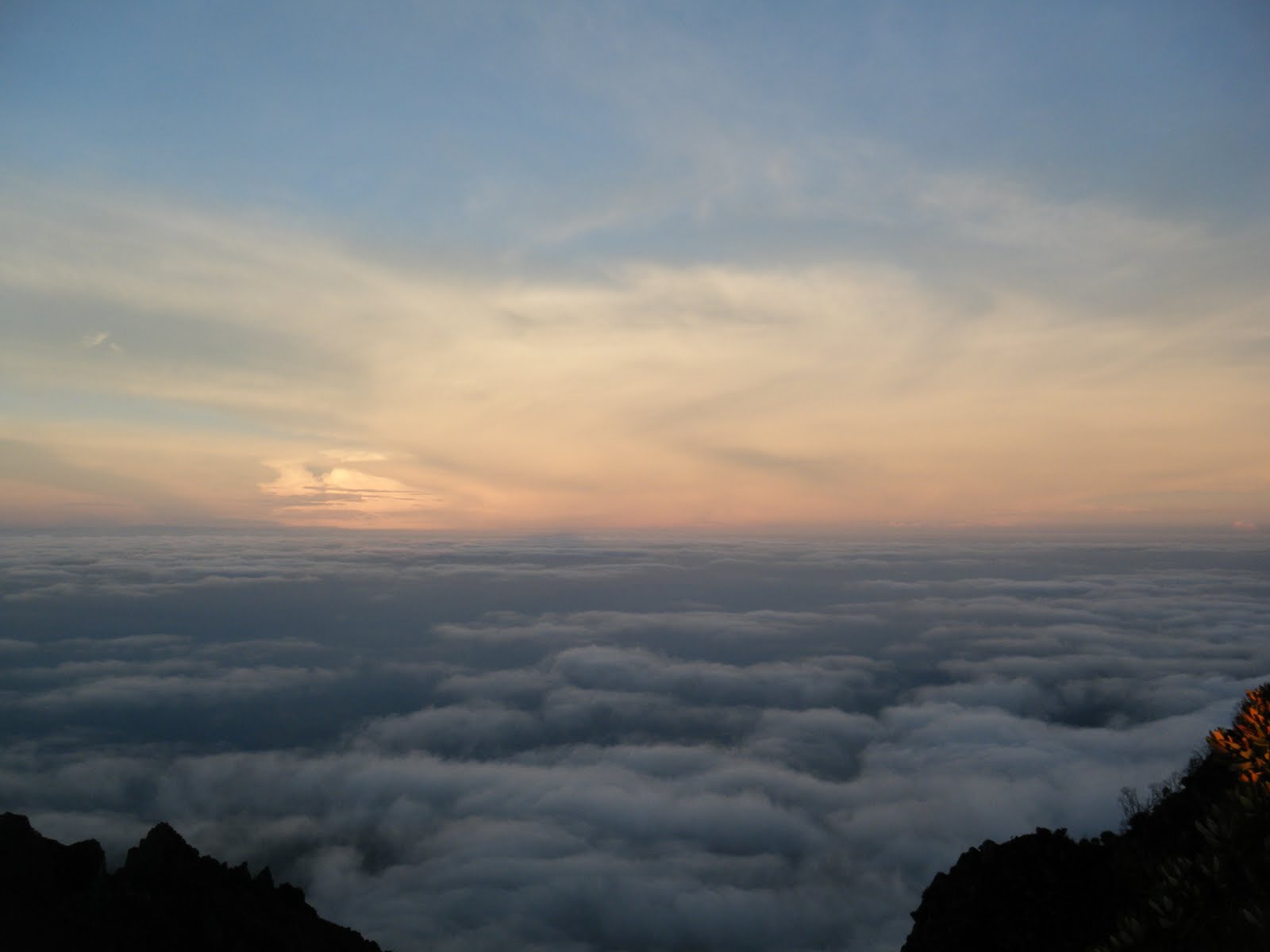
By around quarter to six, strips of orange and green began to break along the horizon line and we sat there, above the clouds, waiting. On a clear day, you can see both the Pacific and Caribbean oceans from the summit. Our day was a little cloudy, but the view was still completely magnificent in its own way as the sun came up, casting colors into the fog, clouds and sky that we felt a part of. We stood at 11,398 feet looking down at clouds below, at the hills and the swirls of white, orange, pink and blue that surrounded us. Fatigue in our legs was forgotten, the hike down wasn't a concern because the breathtaking view trumped everything. The pictures below can't quite capture the natural beauty.

At about 8a.m., 10 hours after first starting, we began the descent. A lot of people say going down is harder, especially if you do the overnight hike. We hadn't slept, were already sore from the ascent, and the adrenaline was fading. It took us about four and a half hours to get down. The last 90 minutes were pretty brutal, with the impact of each step pounding into my knees and ankles, and the effects of pulling an all nighter while walking a total of 16 miles and climbing up to an 11,000 feet peak beginning to make themselves known.

But this trip will be one of my favorites in Panama. The combinaton of physical strain followed by a resplendent reward was the kind of experience I needed to relieve some in-site stress and remind myself that I am surrounded by natural beauty and fortunate to live once-in-a-lifetime experiences all the time in this beautiful country.


Saturday, April 16, 2011

A taste of the tranquilo

You may remember I told my brother James that he would be obligated to write a blog entry about his trip this time around. He has delivered on his promise with an interesting comparison between the Panamanian and American ways of life. My idea of happiness and fulfillment has certainly been re-framed by my time here, and he does a good job explaining how and why his ideas have changed too. Here it is:


------------------------------------------------------------------------------------------------------

As I return to Panama for the second time, I am struck by how simple life is here. Life out in the country is usually a very straight-forward arrangement. People have a few acres of land with maybe a few cattle and a few banana and orange trees. It seems as though people have very little, but they get by. In fact, they really need very little. Many of them are farmers and they live in what could be described as a giant greenhouse. There is no winter. A small cinder block house with a tin roof and some bright paint seems to be enough for a lot of people. Whenever they need money they do a bit of work or sell some of their cows or bananas, just enough to get them through the week. Overall the life of a farmer in Panama seems pretty easy and idyllic. With all the rain and sun one could hardly fail as long as they put a few seeds in the ground. Life certainly seems a lot easier than back in the US.


Amazingly, even though people in Panama have almost nothing to their name, they seem not to care. In fact, they seem quite a bit happier than the average American. I think it may actually be because they all have so little that it is hard to feel poor when there is no rich person next door to compare yourself to. There are no Joneses in town to keep up with. If a person has a fully-feathered flock of chickens, they are rich. They don’t seem to want electric service to their house as badly as most Americans want, say, an iPhone 4, because no one else in Quebrada Pastor has electric service. They worry about other things, like who is going to win the next pick-up baseball game.


One of the thoughts that goes through my mind is "man, wouldn't it be great to live like this?” To be on an almost permanent vacation with a 10-hour work week. To be free of the 1000 commitments the average American has to deal with on a daily basis. To have time to spend living life instead of sitting behind a desk or watching America's Next Top Distraction. Wouldn't it be great to be in charge of your own life, even if there wasn't much to be in charge of? What would I be willing to give up? At the end of my week in Panama, staying in Catherine's house I was right at home and I felt like I could have got by indefinitely with just my toothbrush and a few changes of clothes, if for some reason my big American pile of stuff back home suddenly burnt down or disappeared. My life would different, for sure, but would it be any better or worse? That’s hard to measure.


We think we are better off in America than the average Central American because we have more stuff. In some ways we are, for example I don't plan on dying of Cholera any time soon. But in many ways, we just have a bigger sand box with more toys but no more meaning. If we are better off we ought to be healthier, happier, feel more secure, have move free time, more friendships and more meaningful experiences in our lives than Central Americans. But they seem to beat us in all these categories. Americans are more obese and have more cancer than any other country. Costa Rica actually has a longer life expectancy, even though their hospitals are not nearly as advanced. In Panama people have strong ties to their neighbors and extended family which have not existed in the US since before the depression. Here we seem to be afraid of everyone and everything, we live to work, we spend our free time on escapism and even though we are the richest nation somehow we still feel poor and rack up debt. There is no way to declare success. There is always more stuff to buy.


So it seems like the thoreauvian thing to do is to go to Panama, build yourself a little shack in the jungle and love life. Panama is the place to go, you see, because it is the home of the tranquillo lifestyle and the only place one can live a low-key life. This was my immediate thought - you have to move to Panama to live like this. But what is to stop me from living like this in the US? I could make a little cinderblock shack, buy a couple acres of forested land real cheap and live just like a Panamanian. I could even cut my lawn with a machete if I wanted to. I could do all the same things here and it should be equivalent. But what would the neighbors think? I would seem crazy. I would seem so terribly poor in comparison, without that speedboat I proudly display in my front driveway to impress my jerk neighbor even though I'll only use it twice in three years then sell it because I can't make the payments on my McMansion. People would think I was too lazy or too stupid to work. What would I do with all my free time? Shouldn't I be working at a job I don't like to buy stuff I don't need to impress people I don't care about? I would be crazy not to.


Coming to Panama and seeing a different way of life has given me a great check on reality. It has allowed me to see how loose the correlation between money and happiness is, and how important your actions and attitude toward life are. It reminds me that I don’t want to be answering emails from the office at 10pm on a Saturday on my Blackberry no matter what my salary is. Hopefully these are lessons I can take home with me so that I don't get distracted by the American dream and can be truly happy.

Saturday, March 26, 2011

James´ visit

My brother James is a really good sport. He arrived in Las Tablas after a long day of travel and was immediately immersed into the 24-7 chaos that is Panama´s Carnaval. It is quite like Mardis Gras, but involves a lot more hoses spraying people, beauty queen parade floats, and pop-up clubs in which one is free to dance the night away. He jumped right in to the fiesta without a complaint. He met a bunch of my Peace Corps friends, all enjoying a couple of vacation days, and soaking in the sun, pushing through crowds, and subsisting on what we all lovingly call street meat.

From there, we spent a four full days in my site. He got to know the local kids really well and get a real taste of what a normal day for a PCV is like. There aren´t many people I feel like I could bring into my community and not feel worried about how they would do or view things. But James is one of those people I knew who could handle it and thrive, just like he did at Carnaval! The kids fell in love, and many of the adults told me they thought he would make a really good volunteer and asked about his availability come October, when I leave. I said our mother wouldn´t have it.

We finished our time on Bocas Island, eating bacon, burgers, and really good Indian food. I told James the only condition for his visit was that he had to write me an entry for the blog. That will be coming soon. In the mean time, here are all the pictures from his visit.

Wednesday, August 18, 2010

We Heart Seminars

In the last month, I´ve helped out with three seminars in three separate volunteer sites. We PCVs have become savvy to the fact that our community members respond better when we call something a ¨seminar¨ instead of a charla, and invite a few other volunteers along to help out over the course of a few days. I think they like the idea of a one-time commitment and a more formalized environment of a seminar or workshop . Oh, and the free food. The PCVs always get a kick out of the fact that participants LOVELOVELOVE the visiting volunteers when they seem so luke-warm about the ones in their own sites sometimes.

In mid-July, my friend Dan held a two-day health seminar for the women in his community. I came for the second day to do a charla on S.T.I.s and HIV/AIDS.

Here is a woman receiving her certificate of particpation:


More interestingly, Dan has a monkey:


This is his house:
From there, I headed straight to the Comarca, and after a 90-minute hike, arrived in Aleah´s site to help with a water seminar. They are becoming very popular activities for EH-volunteers. Over the course of a few days, we educate water committee members on virtually everything they need to know about their systems--the nuts and bolts of how the water travels through the tubes, how to clean the tanks, how to repair damages, how to decide on a quota, how to run better meetings, you name it. Aleah has a beautiful site on a ridge, and this is the view from her house (sooo jealous):

One of my favorite participants:

Another PCV Dan, leading a session on thermoforming-- a method of molding tube using hot vegetable oil. Creates tighter fits and is safer than the more popular burning-PVC-over-open-flame method.


Then, last weekend, I went to other PCV´s Myles site, close by here in Bocas, to do a PML with his junta local and water committees. Here I am talking about how to work in teams!


On my side,I have been continuing with the sex-ed and life skills charlas with the 8th and 9th graders in my school. It´s going well, and they´ve impressed me with their candor and willingness to ask questions. More on this to come.

I´ll be bringing whoever I can convince to go from my community to a water seminar in nearby Punta Peña for them and three other volunteer sites in mid-September. They are daunted by the overnight stay and the four-day length, but with my diligent persuasion techniques,I hope to wrangle in a precious few. Sigue la lucha...

Friday, June 4, 2010

My first year of medical school (updated)

So by now the secret´s out that I harbor delusional fantasies of practicing medicine, but posess neither the will or the skill to actually pursue a professional, (legal), career. But you know? Sometimes when you really want something, you are provided with opportunities. (I think I just heard you all roll your eyes.)

Yesterday I went to the nearby community of Valle de Agua Arriba, where another Peace Corps volunteer is wrapping up her service. The community was hosting a gira medica, which is essentially a traveling clinic made up of doctors, dentists, vets, and students, that descends on a town for a day and sees as many patients as possible. Unfortunately, I didn´t get to see much of what was going on in the medicina general room, but that all sounded quite boring compared to where I was stationed in the dental room.

Of course, my role was to translate for the students and nothing more, because none of them spoke a word of Spanish. And for a rural population who has never seen a dentist and has trust issues with gringoes and foreigners, my services were appreciated by both parties. I felt most useful when even the Spanish-speaking Costa Rican doctors asked me to speak with patients to explain medicine or treatment, because they could tell the Ngobes were more willing to listen to me.

But besides all of that, I got to see some pretty gruesome tooth extractions, record-amounts of plaque scraped off teeth, and explained how to brush teeth about 100 times (I have never seen anyone in my community brush teeth. Toothpaste is sold in the tienda, but I am quite sure I am one of perhaps three QP dwellers who purchase it.) I also felt the fierce defensivenes I´ve lately been experiencing when it comes to ¨outsiders¨talking down, or badly about the people here. It´s easy for some people to criticize when you have no idea about the context of their lives.. But people who have never lived alongside them, haven´t seen them haul buckets of water for 15 minutes uphill just so they can cook, or seen how little money they really have, cannot understand all of the barriers poor, rural populations face in trying to be healthy.

In between translations, I did decide dentistry will not be the fake medical-specialty I adopt in the vast vallies of my imagination. It is the only area of modern medicine that makes me cringe more than orthopedics.

Other Asuntos Varios on the health front:

So if you are wondering how my feet are, the answer is much better, thankyouforasking. The infections are gone, and I had a blood test today to make sure there were no more creepy crawlies hanging out in my blood. Luckily, there were not, but there are some other creepy crawlies hanging out in my skin.

So I had been suffering from a REALLY SEVERE ITCH ALL OVER MY BODY THAT WAS DRIVING ME CRAZY for about two weeks. Like crazy itching, especially at night, when I would wake myself up digging at my skin like a mangey flea-ridden dog. Then I broke out in a rash on my knees, which was a charming addition to the scars, cuts and bites that already inhabit my legs. These gams are getting pretty hard to look at, folks.

The doctor says I have scabies, and all of their egg-laying and pooping under my skin causes an allergic reaction. Which is beyond disgusting. I hope he is wrong and it is just an allergic reaction to the jungle. He didn´t dwell very long over the diagnosis, just pointed to two nearly miscroscopic dots on my scratched-up hand and said ¨That is where it went in, and that is where it went out!¨

So let´s allow ourselves to float around in the hopeful fantasy that it was a hasty, incorrect assessment. Because even though I am an imaginary medical professional, mites burrowing around in my skin is just a little too Victorian-England-jail-cell for my liking. Furthermore, you usually need to have some close human contact to get scabies, if you know what I mean, and I am a very single young lady living a very single life in the jungle. If I caught this wretched disease from having kids crawling all over me, then well... NO MORE COLORING AT CATI´S HOUSE!! Scabies... seriously?

So anyway, I am in Changuinola for the weekend, getting some PC work done and catching up on some R and R before I head into a marathon couple of weeks doing stuff in site. You might be hearing from me again.

Thursday, April 1, 2010

Notes from the Clinic...Again

In my last post, I briefly mentioned the raging infection that was waging war on my delicate, ballerina-like size 11 boat feet. It was maybe a little worse than I was willing to admit, but I really wanted to get to this conference I was attending with my community counterpart. I had taxi´d myself back to the bus terminal, where I ran into my friend Louis, another Bocas volunteer.

¨Good GOD WOMAN! What is that on your feet?¨

¨Oh, does it not look good? It´s just a little infected...¨

¨You need to go to the clinic. That is, um, well-- I just can´t believe you haven´t gone yet.¨

But...but... I already bought my bus ticket. I hobbled off to buy a sandwich and contemplate the value of my health when I received a call from my biological brother James, who told me had he had been to the hospital with a septic foot infection, caused by some kind of strep bacteria. (Which he got when we went snorkeling. I officially retract my approval of that activity. Snorkeling is a dangerous, deadly activity, and you should never do it. Who wants to see fish anyway? They are ugly creatures and coral deserves to be in danger of disappearing forever. Coral is a dummy.)

¨You really should go to the clinic,¨ bio bro James advised.

Well. Septic foot infections and strep bacteria sounds kind of dangerous, so I called my Peace Corps doctor, Lourdes, for her advice.

¨Catherine, now more than ever, please please please go to the clinicLourdes doesn´t play around, so I hopped in a taxi and headed to David´s Clinica Cattan, and after a five-day stay, I bring you:

TOP FIVE LESSONS LEARNED WHILE HOSPITALIZED IN PANAMA

Because, while my Mom can´t laugh about it, why can´t we? (Seriously Mom, stop reading.)

5. Medical confidentiality does not exist. Every nurse who took care of me told me that my compañera, Mary, who I have never actually spoken to, was also admitted to the clinic. ¨ She has diarrhea,¨ they said, while making the Panama diarrhea gesture. No such things as HIPPA here, people. Good thing PCVs share this information with each other anyway. When Mary was released, I heard about that too, and the nurse gave me a sly smile and said, ¨ She beat you.¨ Thanks for rubbing my interminable stay in my face. *Mary´s name has been changed because no one needs to know about her diarrhea.*

4. Panamanians like to make you feel lonely. Everytime my phone rang or buzzed, they began:
¨ Is that your Mom?¨ No.
¨Is that your boyfriend? ¨ No.
¨Is that a friend? ¨ No. It is my cell phone provider, offering me a promotion, THANKS FOR ASKING.
"So, you are here all alone? No one is coming to see you?" Yes, for the hundredth time and I didn´t mind until you started pointing it out every hour on the hour. My friends, Tyra Banks, Chandler Bing, Bree Van de Kamp, Paris Hilton and Dr. Derek Shepard, are on the TV. I haven´t seen them in months, and could you just leave us alone?

3. When I arrived and showed the doctor my foot, the only thing he said about it before he admitted me was "That is ugly." I did not hear from him again until the next day when he announced that it was a little bit more pretty, but still not good. The next night, the Mean Nurse who cleaned the wounds with such vigor that I cried myself to sleep, announced the infection on one foot was pretty, but the other one was still feojito, the dimunitive form of the word feo, meaning ugly. Apparently this is the only means medical professionals here have of assessing illness. James joked around that all their medical charts consist of are boxes that say Ugly or Pretty, and you check one, and makes notes in the margin. I am afraid to say I think he might be right.

2. There is no need to check on you, ask if you are comfortable, and if they forget to bring you dinner, that is okay and no one will apologize or find you a suitable meal. They did manage to change my sheets every day, once waking me at 4am to do it. Florence Nightingale would be thrilled. But basics such as providing me with water or meals were forgotten. One night when they didn´t bring my dinner, I eventually asked for it, and a wash of guilt swept over the nurse´s face. She came back in 20 minutes with cold broth and a cup of jello. Not enough, people. Not enough.

1. There is absolutely no reason to provide a patient with a diagnosis, any information about the medicine you are giving them, how long you expect them to stay, or what progress they are making.

I hail from the Massachusetts Bay Colony, home of Mass General, Brigham and Women´s and some of the top physicians and specialists in the world. I am not used to this sort of neglect and ambiguity when it comes to medical care. Everytime they put something in my IV (and oh, in five days there was a lot going into that IV), I would ask what it was, and the nurses would look slightly annoyed with me for asking, and offer a vague answer like "for the pain" or "for the swelling" or "to make you stop asking questions, gringita." Okay, they didn´t say that last one, but I think they wanted to. One time, the nurse came in with a huge tray of about 8 syringes filled with medicine, and started shuffling through them before she asked, "What´s your name again?" Good grief. Needless to say, I tried to double check as much as possible.

As far as a diagnosis, the doctor did not tell me what was wrong with me until Wednesday, my fourth day in the hospital. And you know? When someone has a FLESH-EATING STREP INFECTION in both feet, it is something you might want to tell them. Just as a rule. I didn´t realize how serious it was until that moment, and I kept thinking each day might be the day they let me out. Thanks for the memo, doc.

So yesterday they released me with a bag of medical goodies and lots of instructions about how to take care of my wounds in site. They are almost all better now, no swelling or redness, and about half their original size. Despite this list, I think they did a good job overall of taking care of me (by Panama standards...) and providing me with an outstanding amount of antibiotics to kill the infection. But I will say the experience made me appreciate American medical care, flawed as it is. We are used to doctors telling us what´s going on and how they will treat us. Not so much here in Panamania, but that doesn´t mean I will stop asking for information. Gotta be your own advocate. I go back on Tuesday to make sure they are healing and to yet again revel in the world-class medical care they provide. Let´s hope I don´t come back from that experience with enough material for another Top 5 list.

Sunday, March 28, 2010

Brace yourself, this is going to be a long post

Saludos, everyone. How are things? I hope this post finds you well. I am well-- currently free of parasitic infections and only battling a fungus-turned-jungle-infection on both feet. It is big, disgusting, and emitting a pus-y effluvium. It makes me limp, which earned me a discounted taxi fare this morning. Look at that poor gringa, all Tiny-Tim like wandering down the streets of David, lost and alone. Pobrecita.

That is why you come here isn´t it? Because I write about things like pus-y effluvium that happen as a result of, well, just being filthy nearly every day of my life. I am glad I can provide that for you, because really, who else would? Pus-y effluvium. You love it.

But fret not, loyal readers, I am not going to talk about bacteria, excrement, or parasites today! I am going to talk about something grander-- my vacation! Indeed, a week ago my brothers came to Panama and oh! We painted the country red. I will condense the week for you in a still-not-condensed enough summary, using James´s pictures. I lost my camera charger, so I took none. I am eternally sorry that I continue to fail in my picture taking. Probably will end up buying a new camera. Sigh.

Pre-Vacation
The night before I picked up mis hermanos at the airport, I stayed in Santa Clara with my very first host-family, with whom I stayed during training. Greysi saw me coming up the hill, ran down right away, hugged me and began filling me on school and everything that matters when you´re five. It was great to spend some time there again, and I could tell how much it meant to them that I came back. I played Bingo again with Nani and her mother-in-law. I cleaned up. For breakfast, she made me pancakes, a hot dog, and french fries. Oh, it was good to be home.

Seeing Santa Clara again after having spent time in my community was enlightening. During training, I remember thinking how there was nothing really there, it was just a small, suburban town, safe and simple. When I rolled back in this time on a Diablo Rojo, I couldn´t stop thinking about how developed it seemed. It has a health center, a playground, a library (generous assessment of a few piles of books lying aruond), a market, a town hall-ish building, latrines, an aqueduct connection at every single house. IT HAS EVERYTHING. It is a bustling metropolis.

Day 1- Saturday, Panama City- Casco Viejo.

Casco Viejo, as its names suggests is the old part of Panama City. When the Canal was built, the entire city was in this area. Today, it is filled with old churches, some delapidated, some restored, charming cafes, and is relatively free of chain restuarants, cell phone stores, and other eye sores. Lonely Planet says it´s like Old Havana. I have never been to Old or New Havana, so I cannot confirm or deny these claims, but you get the idea. It´s pretty and old and rustic and changing and filled with street markets, gelatto shops, ocean views, and historical monuments.


Where we stayed: Hospedaje Casco Viejo. Simple, clean, $10 a night with charming and patient desk people.

Sites: Iglesia de San Jose- famous for its golden altar. When Captain Henry Morgan came to Panama to pillage, plunder and shiver the timbers, he headed for this famed piece, which the priest had sneakily painted black. When Morgan came, the priest told him it had been stolen by another pirate and somehow convinced him to pay for a replacement. Morgan reportedly said, I don't know why, but I feel like you are more of a pirate than I am!¨

Panama Canal Museum- Worth a trip as admission is only $2, but only if you have a bit of Spanish. There are no signs or exhibits in English.

Plaza de Francia- a beautiful walk along the ocean, with stones paying tribute to France´s work on the Canal. They abandoned it after losing 22,000 men to yellow fever and malaria.

Eats: Cafe Coca-Cola, a charming restuarant diner-- the only diner-like establishment I´ve ever seen in Panama. Good service, good food, great coffee and cappucinos. An old neighborhood staple.

Days 2 and 3

We hiked the Cerro Punta to Boquete trail alongside Volcan Baru. It took us about 4 1/2 hours, and we weren´t hurrying. An easy hike, although we did it down hill, and next time I´d like to try it going up (I developed knee problems since arriving). The trail is famed for the resplendant quetzal bird which is abundant in the area. We heard dozens of calls, but couldn´t spot one. This part of Chiriqi is traveled by birdwatchers from around the world because of its hundreds of rare species. Bring your binoculars.


The next morning we awoke en la madrugada for a 6a.m. coffee tour. Imagine how thrilled Michael was. But it was worth the intial agony. We opted for what the hostel owner called the more rustic of two tours, and were picked up in a car at our door just after 6:30. Our guide was Feliciano, an adorable and enthusiastic chiriquano (guy from Chiriqi), who began the tour by taking us, and a German couple who joined us, to his house. He offered cups of coffee as we stood on his porch in the chilly morning, watching the fog roll over the hills and looking down at the coffee finca he inherited from his father. He grabbed us bananas for breakfast, and told us the story of his family, his plants, and how he grows, maintains and harvest them. He spoke all in English, only occasionally asking me to translate a word. This man is adorable. And tiny, which made his comments about the indigenas being too short to pick coffee awfully strange. If you come to Panama, we are going to visit him, because he does other hiking and nature tours and I am sort of in love with him in a non-threatening will-you-be-my-uncle-or-grandfather-or-wise-advice-giver kind of way. Felciano, mi corazon, my heart:

The tour continued with a visit to a small factory, where they roast the beans in batches no bigger than 50 pounds, usually much smaller. We saw where the beans are peeled, dried, and toasted. They roasted a few handfuls for us so we could taste the difference between light, medium and dark roasts. Turns out the differences is only a matter of seconds. We´d always thought it was much longer. I highly recommend searching out a smaller, more personal coffee tour if you´re interested. We were a small group of five, and loved the interaction and ability to ask questions and converse freely with our guide (no, you guys, I really love him). And it´s a better way to spend your money--supporting small farms and independent roasters. $25 for a 3-hour tour and round-trip transportation.

Then we went to Mi Jardin Es tu Jardin (my garden is your garden), a sprawling flower garden open to the public. For free:

Lodging: Hostel Gaia, $11/night, full use of kitchen and they helped us book coffee tour. Also worth mentioning- tried to book at Hostel Boquete, which was full, but the owner kindly called Gaia and drove us over there in his car. Will try his place next time-- has a restaurant, bar, and hammocks overlooking the river. DONE.

Eats: Amigos restuarant. Sat outside on the patio in the cool evening, illuminated by white Christmassy lights. Yummy food and had a glass of my favorite wine available here in Panama for $3.


Day 4: Visit to Cati´s community

You´ll have to ask the boys what they thought (comments are open), because I of course am rather jaded by all of this by now. We arrived late Tuesday night after a death-defying bus ride through intense fog on washed out roads. I messed up a batch of kettle corn, but the boys set up their mosquito nets and we settled in for a long summer´s nap. The next morning James and I headed up the hill to my first host family´s house, hung out, and drank some cacao with mom, sister, and brother. He bought a chakara made by sister Arcadia. They are always trotting out their wares when a gringo comes along! The hike up took a rapid 25 minutes instead of the usual 40ish, due to the driest trails I have every seen. Gringo fam meets Ngobe fam:

Don´t they look thrilled? Do I look like I am about to ride a horse? I think I do.

Then we bajared the loma, to return to Michael B., who had slept in. On the way, James got some awesome shots of some leaf-cutter ants:


Then we pasear´ed, and James and Michael delighted in how easy it is just to wander around from house to house. I named a baby, and they bore witness to the chorus of CATIs that follows me every where I go. Celebrity status.

Typical exchange with Ngobe chi´s, (kids):
¨Cati! Cati! Cati! Cati! Cati! Cati!¨
I finally answer, ¨Dime mi amor!¨ Tell me, my love.
¨Hola!¨

or:

¨Cati! Cati! Cati! Cati! Cati! Cati! Cati! Cati!!¨
¨Dime, guapo!¨Tell me, handsome!
¨Buenas!¨

Bocas Island, Days 5-6.

And then we went away for our tropical island retreat. Highlights included, a beach paradise, nestled in a national park:

This visit was part of a touristy boat tour James and I went on, including a visit to Dolphin Bay, where you see dolphins. Imagine that.

And... wait for it... do you know what I did?

I went snorkeling. Because my brother James wanted to and I love him and I will make sacrifices. The first 7-10 minutes involved hyperventilating, thinking I was going to drown, die and be eaten slowly by fish and anemones and other marine creatures whose existence I prefer not to acknowledge. My heart raced, I sucked water in my snorkel and generally flapped around like, well, a fish out of water. Except, you know, I was in the water, with the fishes, and do you know the water was about four feet deep, and they were all so close, and they could touch me at any minute? Does my brother love me? I hope so, because this is horrifying. And then I calmed down. And I looked at the fishes, and the coral, which was beautiful and purple and turquoise and yellow, gold and green. Like something out of Planet Earth. They were nature´s big treasure chests hiding under the ocean for us to discover. It was lovely. And I only freaked out and splashed away from fish closing in on me a handful of times. And my heart only legitimately stopped once when I saw a menacing black fish the size of a dinner plate looking at me. Of course my heart started beating again, and I am glad I went.

Other highlights: An amazing Caribbean dinner, James with our fish, in garlic and creole sauces, respectively, and sides of coconut rice. And Michael with his.... well, just look:

Have you ever? Pescado Entero.

Boys´Beer Tour: One night we hung out on the roof deck of our hostel, and the boys sampled five of the widely-available Panama beers. I watched and classily drank wine because I do not participate in such pedestrian tomfoolery. But it was a joy to watch my brothers debate the finer points of really not fine beers.


Where we stayed: Hostel Heiki, $10 a night, super Peace-Corps-friendly with the nicest manager on the planet. Roof-deck with tables, chairs, sofas, hammocks and computers. Kitchen, free coffee all day and pancake breakfasts. Nice view of the street and park from balconies and decks. Fun to gawk at all the gringoes.

So I thought the vacation was a blast, and we did it cheaply. I spent under $300, including all lodging and transportation, and I didn´t hold back. Eleven dollars was the most we spent for lodging, and though we ate some nice meals out, we also got some heaping plates of good Panamanian food (chicken, rice, beans, salad, and Coke) for less than three dollars. So thanks for coming, boys. And to everyone else, I look forward to your visit. Look at the rest of James´ pictures here.

Sunday, February 21, 2010

Escojo Mi Vida

Just arrived at an Internet cafe in Panama City after facilitating a four-day personal development and sexual health seminar at the Lions Club facility here. Every volunteer in the country had the opportunity to nominate two kids from their community to an all-expenses-paid seminar. For many kids, this was their first time out of their province and certainly the only time they´ve gone anywhere without a family member.

I invited two kids from my community. It wasn´t easy getting them here; I had to talk their parents through the seminar many, many times and go over the intinerary until I was blue in the face. But who can blame them? A gringa wants to send their child to a personal development and sexual health seminar? In Panama City? What in the world is sexual health? Despite my enthusiastic explanations, I am still battling the will-this-gringa-kidnap-my-child stigma, and had to lay on the charm even more thickly than usual to convince them this was a good thing.

But anyway, it all worked out in the end, and I had an absolute blast facilitating sessions on everything from establishing goals, identifying goals, problem-solving, pregnancy, HIV/AIDS and STIs, to the obligatory condom demonstrations.

I´ve written here before about the pena many Panamanians and especially indigenous people have here in Panama. Almost everything embarasses them, and they are not used to talking frankly about anything. Knowing this, I was expecting a lot of uncomfortable, silent kids who were wondering what these crazy gringos were going on about.

Amazingly, it was the exact opposite. Thanks to some great planning on the part of the PC Gender and Development (GAD) team which puts on the event, all the PC volunteers were straightforward about everything from the beginning. I think this helped ease the embarassment tremendously, and we mixed up with lots of dinamicas, games, skits and competitions to keep things rowdy and fun.

There were group presentaitons on the main topics, and then two facilitators worked with groups of eight or nine kids one-on-one. I was amazed how mature everyone acted and how willing they were to ask questions. I doubt I would have responded as well to all of this information when I was 13 or 14 years old, and you know? I still struggled when two of the girls in my group asked with no pena what oral sex was.

Oh, every day here in Panama presents its own challenge.

But this seminar has been one of my favorite experiences as a PCV here, and I can´t wait to bring some of the charlas back to QP. Now that two of my kids have attended, I plan to drag them into co-facilitating.

Now I am off to reunite with everyone from my training group for a week of in-service training. After spending nearly four months in site, we know better what is needed and can attend whichever sessions are most important. And in every free moment, gab about everything that´s happened since we last saw each other. We´ll all have a lot to say.

Friday, November 27, 2009

Gobble Gobble

I´ve been in Panama for a about three and a half months now, and it recently occured to me I´ve already seen so much more of the country than most of the people I´ve met in it. Three of the four siblings in my first host-house have never been farther than Changuinola, Bocas´s main city, which is about 80 minutes away from my site by bus. This is true for many adults in the community as well. Only a few have ever been to Panama City, and even fewer have been anywhere else.


Which make me grateful for the opportunities I´ve had to travel around during my short time here, and especially so because I was able to head to the mountains this week to a town called Cerro Punta, near Panama´s only volcano,Volcan Baru, and highest peak. It´s frequented quite regularly by tourists, as the hiking trails on and around Volcan Baru are the best the country has to offer. It´s also known for its strawberries, with farms lying around every bend in the winding roads, and street-side stores selling strawberry jams, breads, milkshakes, and everything in between. The area feels distinctly un-Panama-like however. The weather was cool. I wore a sweater both days. The homes, stores, and lodges are all vaguely-European looking. Many of us felt as if we´d somehow landed in some forgotten Swiss town, and had to keep reminding ourselves that we were in Panama.

It was a treat to see all of my Group 64 volunteers again, and also to meet dozens of other volunteers from other sectors and regions around the country. We ate delicious breakfasts, with yogurt, granola, fresh fruit, and strong, sweet coffee every day. I couldn´t believe what I was eating, after existing for a month on a diet that consists of little more than rice, boiled green bananas, canned sardines and the occasional legume.

Thanksgiving dinner was an incredible site, and an even more spectacular culinary experience. Trays of food just kept coming from the kitchen. Platters of turkey and ham were endlessly refilled. Pumpkin pies lined both sides of the table, with vats of freshed whipped cream standing by. Heaven-sent green-bean casserole, cranberry sauce, apple crisp, garlic mashed potatoes, squash, sinfully rich hot chocolate made from Panama cacao. You name it, I ate it. Absolutely no restraint was shown on the part of any volunteer. I ate so much that I was in considerable pain for hours after. This is not a complaint. I was the happiest I´ve been, belly protruding and largely immobile on the couch. Some other volunteers somehow had the energy to dance after dinner. The owner of the lodge cleared the floor, and a full-on dance party ensued, which I watched while I digested and thought about how often it feels like I live in two very different worlds. The restrained, and sometimes solemn Ngobe/volunteer life, and the other one, when I´m with other volunteers, feeling entirely human, normal and comfortable in this tiny S-shaped country that we all (some grudgingly) have come to love.

I slept in a bed, took hot showers, drank unlimited amounts of coffee from the lodge, relaxed, and took in the scenery. It was an idyllic two days, and was a great reminder of all there is to be thankful for, especially when many of us come from communities where there isn´t enough food for everyone.

I am returning to site this afternoon, and on Sunday, will be moving in with my second host family. The house if further from the road, and more isolated in the community, but it will be a great opportunity to get to know new neighbors, take in some killer ocean views, and take advantage of the fact that the señor of the house has tapped a nearby spring, and there is always water running through the pipes.

Sunday, October 4, 2009

Photos and Culture Points

I hope you all appreciate that I am spending our first day off ever here in Panama blogging and uploading pictures at long last. You can view them here.

Today I´m looking to fill you in on the culture points that I haven´t had time to write about in my other exhaustive summaries.

TOP 10 THOUGHTS ON PANAMANIAN CULTURE

10. If you ever took a Spanish class, you learned that the word bastante means "enough." As in, I have enough food, or We have enough time to go shopping. In Panama, bastante is only used to mean a lot or too many. How many grandchildren to you have? BASTANTE. It is a word you usually have to yell. This takes some getting used to, but now I enjoy having a way to express myself in extreme a way as possible.

9. If you ever have to ask directions, make sure to ask at least three people, because they will all give you some vague answer that mostly consists of wild gesturing and pointing with their lips. There are no maps anywhere-- not for public transit, not in malls. Towns don´t have street names, and there are eight different Diablo Rojo buses that can take you to the same place. Speaking of Diablo Rojos, they make up the public bus system here, and they look like this. At first they´re quite intimidating, but they´re really not so bad, as long as you don´t think too closely about the fact that you are barreling down the street in an outdated American school bus with 100 other people packed shoulder-to-shoulder.

8. If they call you fat, it´s a good thing. Within minutes of arriving in Santa Clara, Nani was already on the phone with her friends, telling them a "gordita" gringa had arrived. By the afternoon, Greysi was rolling up my shirt and pointing to my stomach saying, "asi gordita." For Panamanians, this is a compliment; it doesn´t really mean you´re fat, more so that you´re the right weight. It is also acceptable and normal to ask people how old they are, no matter how old. Go for it. I will miss being able to do this later when I one day return to the U.S.

7. Another vocab twist. "Ahora", despite its dictionary definition, never means "now." If you ask when you should do something, and someone says "ahora," wait at least 20 minutes and ask again.

6. We have been told many times that Panamanian time in general is quite different from American time. When we´re in our sites, if we want to give a charla at 10, we tell people to get there at around 8:30, with the idea that by 10, most people should be trickling in. There is also no sense of urgency in restaurants, where you can sit for an hour before a waiter comes to greet you. If you´re going to eat out, give yourself a few hours. I´ve gotten good customer service in malls or large supermarkets, but everywhere else, not so much. Be assertive.

5. No one can believe that the gringas don´t have boyfriends or husbands, and because of this, they are constantly asking who you have crushes on, who you think is cute, and if there is a secret boyfriend somewhere you´re not telling them about. They also want you to find love in Panama and constantly tell stories of other Peace Corps volunteers falling in love here.

4. If someone unleashes a flurry of uncomprehensible (and sometimes toothless) Spanish at you, and you ask them to say it again, they will almost always repeat/emphatically gesture the only word you understood. Sometimes I am just too tired to ask them again.

4. Panamanian women can do everything better than you. The first weekend here, we went hiking, and I didn´t have boots yet. I hiked through a lot of mud with only sneakers on, and when I came home, Nani was horrified to see my dirt-laden shoes. One day, she set out a bucket of soapy water and instructed me to get to scrubbin´. I was in a rush to get to class, but I thought I did a decent job, but there was mud caked everywhere, and some parts of the shoe would simply never be clean again.

I was wrong.

When I came back, she laughed and told me I didn´t know how to clean anything. My shoes stood before me, sparkling white, right down to the shoelaces.

Similarly, during culture week, I got some sea urchin spines stuck in my foot. When I got home, my host mother noticed I was fussing over them, and once I told her what they were, she immediately ran into the house, came back with a needle, and began furiously digging them out.

There are problems that sometimes you think you can´t solve. Your Panmanian host mother will find a way.

2. The food. Panama is second only to China in terms of how much rice is consumed per capita. When I first arrived, there was a heaping mound of rice on my plate at almost every meal. Portion sizes have been adjusted accordingly now that we´ve realized I can´t actually consume a pound of rice in one sitting. Here are the good and bad about the food I´ve discovered here:

The Bad:
Everything is fried. I am typically served at least two hot dogs a day, and in the morning, it is cut lengthwise and dropped in oil in order to maximize its contact with the deep-fried goodness. These are getting harder and harder to eat. But I might miss them one day, depending on what sort of food I´ll be eating in site.

Ojaldre- This is essentially fried dough that is frequently served with my hot dog at breakfast. I wouldn´t be so opposed it if wasn´t frequently the first thing I eat in the morning.

Fried platanos- these are flavorlesss, starchy, and ubiquitous in Ngobe villages. I ate them every day during culture week. With ketchup, they´re not so bad. It is more the frequency with which I eat fried food that bothers me, rather than the individual foods. Panama´s flavors in general are pretty bland.

The good:

Duros- these are basically homemade popsicles frozen in sandwich bags, but they come in amazing flavors like pineapple, or nansey. Nansey is a small, bitter fruit that grows from trees everywhere here. It is sort of citrusy, but when combined with sugar in a duro, it is the perfect treat. My abuela sells duros for 10 cents a piece, and I am a regular customer.

Pifa- a golfball-sized fruit that also grows everywhere here. A lot of the trainees hate pifa, but I love it. Its starchy and has the consistency of squash. Delicious when dipped in a little salt, and I hear it´s packed with vitamins.

CocaCola- I now have a new appreciation for soda. It is still sold in glass bottles here, and Coca Cola would really be proud of how we flock to any small tienda with a fridge for our daily fix. Further, it´s made with real sugar unlike in the States, and that really makes all the difference.

1. Machetes can be used for everything. During tech week, we used red-hot machetes to cut into 55-gallon barrels for water-catchmen systems. They can also chop down trees, cut up fruit, mow lawns, you name it. I cannot wait to bring the machete back into vogue in the U.S.

Sunday, September 27, 2009

Tech week roundup

I am happy to be writing from an Internet cafe in Panama City, having just arrived from our tech week in Soloy in the comarca. The week dragged on at times, my energy was low, and we hit several obstacles along the way, including torrential rain, lack of materials, broken tools, and everything in between. In the end, we weren´t able to complete our projects in one week, so some PCVs are finishing up what was left on Monday. But as always, I learned a lot, and helped build two pit latrines and two composting latrines from the ground up behind the school buildings in town. And let me tell you, when you are inside the (as yet unused) poop chamber of a composting latrine, you cannot help but smile.

Life in Panama is so different.

We worked hard. I got dirtier than I´ve ever been. I will let you know my host mom´s reaction when she sees the clothes that come out of my backpack. I am preparing myself for 30 solid seconds of head shaking and eye rolling. This stuff is filthy. On Friday, we gave a charla to some of the middle-school-aged kids about how to use and maintain composting latrines. It is strange how acccustomed I´ve become to having only a few hours to prepare entire Spanish presentations. And you know? When there´s no electricity, your flashlight is broken, and the kerosene lamp is shooting out flames, you can´t really prepare anyway. So why worry?

Host-family wise, this week was less satisfying than culture week. My host mother was only 18, had a three-year-old, and was still in middle school. When she wasn´t in school, she was working, and if she wasn´t doing that, she was practicing in her dance group, which is traveling this weekened to represent the comarca in a Ngobe competition. Hence, I ate all my meals in a restaurant owned by her friends, and spent most nights by myself. This didn´t leave a lot of room to work on PC´s goals about cultural exchange, but it did mean that I could tuck myself into bed at 8 every night. On Thursday, we did get a chance to see the group perform, and Ngobe dancing is quite unlike anything else I´ve ever seen. Mostly it involves simple rhythmic foot steps, occasionally some chanting and general shifting about. After their performance, they invited the aspirantes up to dance. You can imagine I was mosty unsuccessfuly in my endeavors to execute these moves accurately, despite the insistent efforts of the tiny, tireless Ngobe men trying to direct me.

Tech week was also an opportunity to see the contrast between coastal Ngobe culture in Bocas del Toro, and in the comarca. Soloy is a large town, so I think they are less traditional than some other smaller, more remote communities, but the difference was still stark. All the women wear the traditional Ngobe dress, a nakwa (pronounced nahg-wah. I think I might be spelling this right, but I have no idea.) Their artisan works are everywhere. They carry babies in their hand-made bags called chakaras, and rarely greet or make eye contact with passersby. Ngobes are one of the largest indigenous populations in the world, and I always catch myself thinking about how I didn´t even know they existed a few months ago.

We have a week and a half in Santa Clara, then I leave on Wednesday for my site visit, where I will set up a host family for my first three months in site, meet my counter part, and generally get a better idea of my future home. So many new things in so little time!

Saturday, September 19, 2009

Culture week roundup

Every time I sit down at the computer to write a blog post, I am daunted by the amount of information and stories I have to tell. Today is no different, and worse, I´ve forgotten my notepad with all of my little thoughts and notes I wanted to share.


I´ve just returned from culture week, and my first experience living with a Ngobe family. I stayed in a raised hut with with a mother and father, and two kids, 14 months and four years old on the Island of San Cristobal in the Carribean. When we arrived on Sunday, the whole town was abuzz waiting for the boat load of gringos to disembark, and while we walked through the town to the rancho, we were stunned by the number of children all around. So. many. children. Over the course of the week, they would become some of our best buddies in San Cristobal, running up to hold hands as we walked to class, lifting up their arms to be thrown in the air, and hanging on the legs and backs of the big, burly boys in our group. We spent a couple afternoons swimming in the ocean with them. Ngobe kids loaded up their dugout canoes with PC aspirantes, and we swam around among the coral in water that was still only about waist-deep(my host mom later dug out spines from my feet with a needle. So handy!). We made sure to paddle extremely far out. The environmental-health situation in Isla Cristobal is pretty poor; they do all of their business in ¨servicios¨over the water. Often in the afternoon and evening, the smell of excrement wafts from house to house, especially those whose homes are built directly over the shore.

That aside, I continue to be wowed by the jaw-dropping openness and kindness of the Ngobe people we meet. I would like to say it is my effervescent charm that endears me to everyone, but I can take no credit for how well we are treated.

My host mom was very shy and bashful, and at first. When she spoke it was barely above a whisper. But by second day, she started giggling at my jokes, making her own, and even asked to braid my hair. DISCLAIMER: Only consent to a Ngobe hair-do if you want to look like a fool. At first, I thought she was whipping up these styles purely to humiliate me, but I later found out they legitimately think they look lovely. The first style consisted of several brightly-colored pony tail holders positioned at all angles over my head. Everyone from the PC Bocas group could not look at me without laughing. The last day, my host mom said she had to braid my hair, and I tried to do a little intervention by saying that I like the braids best when they started in the back of the head and go down. You know...I was hoping for something french-braidish. I asked if she understood, and she said yes, but then she immediately began forming two gigantic Clifford-size dog-ear braids down the side of my head, with a violent part in the middle. The braiding continued, and at one point, I asked how many braids she had made, and in one of my favorite moments of the week, she sheepishly replied, ¨Varios...¨

This needs no translation. I spent all of Friday walking around with six braids with neon-colored scrunchies, hearing all the aspirantes laugh at me, barely able to mak eye contact. No Ngobes though, to them, I looked just fine.

The rest of the week consisted of culture lectures, Ngobere classes, walks on the medicinal plant trail, visits to the artisan shops, and even a visit to another volunteer´s community on the other side of the island. We paseared to a bunch of houses there, meeting one incredibly sweet, quietly intelligent older man who told us he stayed home all day from work to wait for our visit. With children tugging and grabbing you, Ngobes eager to teach you their language, and community members peering out their windows hoping you´ll stop by to talk, it´s hard not to feel incredibly optimistic about the next two years of service. Nothing comes easily in PC, but I can already see how the rewards will make it all worth it.

In other news, my Spanish is coming along. In my second language interview a couple of weeks ago, I scored advanced-low, and I am definitely shifting more easily between English and Spanish, and speaking a lot more fluidly. I am grateful that I´m well understood, and made sure this past week to spend a lot of time talking with my host family. Every night I sat out on the porch and chatted for a couple of hours, asking them questions about their life in Panama and answering some of theirs about life in the U.S. I continually found myself struggling to put words to such foreign concepts and realities in our country. For these people, the world is so small. One woman assumed everyone in the United States spoke Spanish. I told her a lot of people took it in high school, but few speak it fluently. She couldn´t figure out how they could forget. Everyone asked about my family constantly, trying to understand how I could be 22 and still without children. They were all worried about my parents, and couldn´t imagine why I would move so far away. And how could they? Most Ngobe families live within spitting distance, who could imagine moving half a world away to live with strangers?

On Thursday, my host mom snuck into the living room, where I had just finished watching Touched by an Angel dubbed in Spanish with Monica, a seven-year-old fan of mine who lived next door. (You may be interested to know, whoever dubbed for the Irish angel kept a slight brogue somehow through the Spanish. Incredibly impressive.) My host mom sat down on a bench, and all of a sudden said she didn´t want me to leave on Saturday, and why couldn´t we do tech week in San Cristobal? I told her my permanent site is close, and I could come and visit soon. She paused, a grin spread across her face, and she said, ¨Catherine, how many stories is your house in the U.S.?¨ I said it was two floors, and told her the floor plan, and she said, ¨You can visit me here, but when can I come and visit you and your family in America?¨

On Saturday, she and Toni, my four-year-old host brother, walked me to the dock to say goodbye, and I tried to thank her for everything, and to convey completely how grateful I was. They stood on the dock and waved goodbye, and I was caught off guard by how sad I was to be leaving them.

As we sped away toward Bocas Island, I realized I have two families in Panama now, in Santa Clara and now in San Cristobal. Nani, my SC-host mom was sad to hear my site was in Bocas, because it would mean visiting her, the Daiveys, and Gresyi would be difficult She hugged me as I left last week, and her concern and advice for me was so genuine. ¨Take care, Catherine,¨she said, scanning me up and down, in disbelief that the sweaty, friendly gringa was venturing out to the rough and wild Bocas province. She watched from the door as my friend and I disappeared down the hill, and again, I was surprised at how sad I felt to have to leave them for two weeks.

We are treated so well here, often times just because people, particularly Ngobes, are so honored and excited to have us as guests. We felt like rock stars walking down the paths in San Cristobal, with kids crawling out of windows and climbing onto porches to yell hello. I can´t wait to see my own community in a few weeks, and to find out what happens when my stay is more permanent, and it´s time to get real work done. The reality of living and working here for two years is starting to hit me. Food is an adjustment, there is very little privacy, and once the gringa-excitment wears off, I will undoubtedly be struggling trying to motivate, and inspire people to change how they´ve lived for years, all in a second language. As rich as some of our interactions have been, I am always wondering when other volunteers taking about having ¨friends¨in their community, how meaningful these relationships really are. How deeply can you know someone when, even though you live together, in most way you are still a world apart? Howevr, weeks like the one I just had always remind me that laughter sounds the same in every language, all kids want your attention, and people always surprise you, sometimes for the worst, but mostly for the best.

In other news, I have a cell phone! I finally called home last night, and the reception was awesome. I think you can get to me by dialing 001 for the int´line, country code 507, then 64101638. I won´t have service when I am in Santa Clara, but I will try to start texting and calling when I can. Once I am in Bocas permanently, I will always have service.

Much love to everyone. I´m off to tech week where we´ll be building a compost latrine, thermoforming PVC pipes for aqueducts, and learning how to maintain, repair and design the lines. We´ll be in the Comarca, where the food will be somewhat less plentiful, and a lot less enjoyable (think boiled bananas three times a day), so I´ll undoubtedly have more to share next week. Be good.

Wednesday, September 9, 2009

Site Annoucements

Thank you to everyone who has been sending me emails. I wish I could send more lengthy responses, but unfortunately my computer time is limited. But know that I miss you all, and am always thinking about what you´re all up to.

As for me, today was the most important day of my training so far. We received our site announcements four hours ago, and I couldn´t be more pleased. They kept us in suspense for several hours, during which I got a serious case of the nervous giggles, leg twitches, and thumb-twiddles. The hour of announcement began with a clip of President Kennedy talking about Peace Corps, and a series of commercials that have aired since PC was started 48 years ago. Talk about drama. They were giving the telenovelas (Spanish soap operas) a run for their money.

The training directors placed a huge map of Panama in the center of the room and said they would announce sites from east to west, starting in the Darien and ending in Bocas. I was called second-to-last, and will be living in a Ngobe site in Bocas, very close to where my site visit was. We only receive a little information about our future site, but from what I´ve heard so far, I´m absolutely elated.

My site has a view of the Carribean Ocean, is predominantly Ngobe, but also has a Latino population. This will be good for my Spanish, as many volunteers are concerned about language loss once they move to an indigenous site. I don´t need to hike anywhere, it sounds like the town is very close to the highway. I was surprised to hear it has over 1,000 people, which was not at all what I was expecting, but I was also told you´d never know there are that many people there. There are only 120 houses total, and while most live close to the road, many others are spread far out. So far out it might take me a couple of days to pasear from one side to the other.

This is good opportunity for exercise.

The site sounds more accessible than I was expecting overall, which means I should be able to get to the Internet regularly, and also to a market to buy the vegetables after which I am constantly lusting. My main project will likely involve composting latrines. The community has demonstrated an interest in them, and even applied for a grant through a government agency, but as of yet, nothing has come of it. They are desperately in need of latrines, as they only have three serving the entire community. Essentially everyone does their business in the creek.

Herego, there is a lot of opportunity for health education as well, which is something I was hoping for and looking forward to. The schools are well-attended and have a larger staff than I was expecting. There is also an existing water committee, and an active community leader who has taken the lead on the latrine project in the past. It is a relief to hear there is some leadership in the community already. Its size is daunting, but I think I was placed there partly because my APCD thinks I could be good at motivating an organizing the groups. Volunteers in Bocas also have a lot of opportunity to work with host-country agencies, like the Ministries of Health, Social Development, etc, which I hope to do also. Our first three months in-site are dedicated to ¨Proyecto Amistad¨or project friendship, and doing a community analysis. During this time, I´ll get a better sense of what people want, what it will take, and whether it´s feasible.

I am thrilled to be in the Bocas province. I´ll have cell reception, several other volunteers close by, and also... when you guys come to Panama... I am very close to Bocas Island, which is the top tourist destination of Panama.

This Saturday we leave for culture week, which will be on one of the islands off the coast of Bocas. After that, we´ll come back through David, and then have tech week in the Comarca Ngobe-Buble. Tech week is for learning more details about how to build latrines, repair, design, or build aqueducts, and other key EH skills. I´ll be away from Santa Clara for two weeks, living with indigenous host families, and spending a lot of time with my training group. I heard these are a stressful couple of weeks, but I´m ready to go in with guns blazing.

I promise to bring my camera this time.

I have so much more to share, but am running out of time. It´s been a chaotic couple of weeks, with tons of presentations, projects, language test, and everything in between. My APCD interview last week went really well. It was a huge confidence boost, and a good reminder of why I´m here. I´lll be in David again later this week, and hopefully I can check in again then. If not, I am sure I´ll have more thoughts than you want to hear once culture and tech weeks are over.

In the mean time, check out the video posted here. We watched it last week, and it shows what some indigenous communities in Panama are like. Might give you a better picture of what PC does here and under what conditions.

Sunday, August 30, 2009

To Bocas and Back

Writing again from the city of David, having returned a couple of hours ago from my volunteer visit to Bocas del Toro. On Thursday morning, Patrick, the volunteer I was to going to visit, surprised me by knocking on the hotel door just as I had emerged from the shower. I didn´t know he´d be meeting me in David, but finding out I wouldn´t have to navigate any buses by my onesies was a pleasant surprise.

After a delicious lunch for the whopping price of $1.85, we departed on a Changuinola-bound bus and rode for about three-and-a-half hours over rolling hills, toward the blue misty mountains of Bocas. Panamanians like to pack their buses tight, and this one was about the size a shuttle you´d see shuffling tourists to and fro in Florida. Ngobe women got on with their children from the sides of the road, barefoot and in traditional colorful dresses. They stood so close their long hair was whipping my face at every turn. As we climbed higher, I could tell I was heading out of familiar Panama and into something completely different.

We got off the bus and sat down to put on our rubber boots, an indispensable accessory in this mud-laden country. We were immediately greeted by a Ngobe man that Patrick knew. Campesino, or farmer/country, Spanish is spoken much slower, a cultural equivalent of a Southern drawl. I could understand more than I expected, even though their language was peppered with Ngobere terms. Hearing Patrick converse with people throughout the weekend helped bolster my confidence that my Spanish would be up to par by the time training is over, more or less. He speaks simply and slowly, but so does everyone else.

The hike was a challenging one; quite steep and I had to frequently pause to pull my leg out of 8 inches of mud. There is something about walking through wet, sopping ground however, those satisfying slaps and squishes really make you feel like you´re going somewhere.

After about 80 minutes, we arrived at Patrick´s site. I was sweating profusely as usual, but eager to take in everything surrounding me. All the houses are raised huts, mostly with roofs made out of penca, or thatch. Some had zinc roofs, but those were exceptions. Penca, while dusty and attractive to critters, is overwhelmingly preferred because it keeps homes a lot cooler than zinc. I know this because my home in Santa Clara has a zinc roof and it undoubtedly contributes to the ever-present gringa sheen. At this point I must interject to apologize and say that again, I forgot my camera. I am failing miserably in my efforts to document this journey photographically, but I promise to do better/steal pics from my fellow trainees. But, your image of a wooden hut with a thatch roof is likely accurate, so continue to use your imaginations.

When we arrived, it was already getting dark, so I rushed away to rinse off quickly before dinner. Patrick´s bathing situation is an interesting but common one. About 50 feet away from his house is a three-sided bathing area with a large bucket and a faucet that usually has running water. I, in technical development terms, would call the water flow a half-hearted trickle but when it works, it gets the job done. Because it only has three sides though, most volunteers wear clothes while bathing, which limits how clean you can really feel. I decided after about day five in Panama that I wouldn´t really feel clean until 2011 so any time I don´t feel filty, I count my blessings.

Is this too much information? Now that we talk about excrement and water-borne diseases all day, I assume this is stuff everyone wants to hear. Any sense of decorum I was clutching onto left me immediately once I landed in Panama.

Anyway. I was interested to see how dinner would be because up until now, I didn´t have a good idea of how or what volunteers ate. Patrick happens to be a master chef, and he works wonders with a propane tank and two burners. We´d hiked up with veggies from the market in David, and over this last weekend, I ate the best food I´ve had since arriving in Panama. That is, if we discount the Dairy Queen Blizzards I´ve eaten in the mall food court. Why has no one told me about those until now? Over the course of a few days, we had spaghetti with stir-fried veggies, oatmeal with flax, wheat germ, powdered milk and sugar, homemade cornbread (I know!), chili, brown rice with squash, lentils, and other goodies, and even crepes. This trip proved to me several things, diet-wise, a) It´s possible to eat well as a PC volunteer b) beans are indispensable c) peanut butter can go in pretty much anything.

Friday, the Ministro de Salud (Health ministry) planned to be working on a water project in Loma Azul, which we were hoping to observe/help haul sand for, but it got rained out. A fierce thunderstorm rolled through, with lightning strikes only a couple hundred feet from our hut. I donned my fleece jacket for the first time in Panama and was thrilled to do so. So Friday ended up being a low-key day. I read a couple hundred pages of my book, laid in a hammock, and chatted with the people as they passed by Patrick´s place. Even though we didn´t do much, it was a useful experience to see how volunteers spend time in a day. PC work moves at a rate slower than a snail´s pace sometimes. Especially in the first year of service, there isn´t much to do the majority of the time. Even when you´re actively seeking out work, doing community analyses, and getting to know people, you have free time. It is one of the most frustrating aspects of service because volunteers feel that they´ve sacrificed so much to be in the Peace Corps, and many of their days are spent idle. So I was glad I got to experience a "tranquilo" Peace Corps day. Also it was the first time I´ve had a free moment since arriving, so falling asleep in a hammock and listening to storms roll in was exactly what I wanted to be doing. I introduced Patrick to Bananagrams and Farkle, and would you believe I was soundly beaten in Bananagrams three times? This was a blow to me ego, but I took in stride because my opponent is also a voracious reader and writer.

On Saturday, Patrick´s friend Jen, and my fellow trainee Aleah hiked from Jen´s site along with the soon-to-be regional leader Ben. The mission today was to give a nutrition charla at the school. Charlas are sort of informal lectures given by PC volunteers in the campo. I pasear´ed with Patrick in early morning, inviting people to the charla. Pasear-ing is sort of the Spanish equivalent of¨going to visit, or to come calling, if you will. A lot of the words we learn don´t have English equivalents, so I´ll introduce them as we go along. Pasear-ing is a huge part of volunteer service. Going to people´s houses, drinking coffee and shooting the breeze is the only way to built trust and relationships in some some communities.

Attendance at the charla was good, about 10 women showed up, some with their children. I was mistaken in my earlier entry when I said many Ngobes are shy and reserved. Most communities in the Bocas area are quite lively, and the women came ready to participate. At some point, we all broke into teams, a volunteer in each group, to make lists of different-colored foods. The women I was with were feeling competetive, and demanded to list the white foods. Good thing too because I don´t know many words for red, yellow, or green foods in Spanish. We joked that our list was the best, and the longest, and indeed ended up winning. I was delighted to talk with community members, joke around, and participate in a charla. We spend hours in training talking about ice breakers, different presentation methods and topics, but nothing compares to seeing what it is really like in person.

Also, I must add. Can you believe what music was playing from the school when we arrived. Celine´s "Because You Loved Me" followed by "My Heart Will Go On."

WHAT!?!? Nothing really compares to entering a tiny school in the mountains of Panama, in an indigenous community, and hearing Celine blasting from the windows. Talk about surreal.

After the charla, the five gringos paraded through town back to Patrick´s house and we spent the afternoon asking the volunteers questions, making lunch, and playing some more Farkle.

This visit was designed to show us what volunteer life is like, and to spend some time up close and personal in a site. I have pretty much nothing but positive feedback for my APCD interview this weekend. Bocas is incredibly beautiful, the communities are less intimidating than in some other areas, and most sites are relatively accessible. They have cell service, and are about an hour away from a town with Internet and some stores. The only downside I saw was that Patrick hasn´t had many big projects to work on. He tried to start some latrine and aqueduct work, but found that people weren´t willing to haul sand or cement up the mountain. Peace Corps is all about building capacity from the ground up, and teaching people how to do the work themselves, and Patrick wasn´t willing to put in effort if the community wasn´t. I think he is exactly right. Unfortunately it means he closes his service without many tangible results, but he did have some big success in giving AIDS/sexual education charlas in eight sites throughout bocas, as well as helping with some side projects in his town.

We arrived back in David at about 12:30 this afternoon and I took the first hot shower I´ve had since getting here. It was glorious and I think my feet are actually legitimately clean for the first time since August 11th.

Peace Corps is all about small victory´s, so three cheers for clean feet!