You may remember that last fall, I purchased a piglet for $25. I did this with the carnivorous intention of raising him 'til he was big and fat, and then killing him for my despedida. Goodbye parties are a big tradition in Panama, and I wanted to make sure there would be enough food to feed the flocks. Plus, it was a good conversation topic. People found it hilarious that I owned livestock and enjoyed asking me how fat he was getting. His name was well-known around town. Puerco de Paz means Peace Pig and is a play on the words for Peace Corps in Spanish, which is Cuerpo de Paz. It was impossible to mention him without grinning just a little.
Purchasing this piggy was perhaps one of the best decisions of my life. The day before my despedida, he was brought down from his house on the hill and my neighbors and BFF's Julio and Rosita took charge of the subsequent slaughter and preparation. Good thing, because when initially face-to-face with the 80-pound hog, I got cold feet and contemplated going into town to buy chicken. I learned a lot of things in Panama, but Intro to Butchery is a course I missed.
The plan was to smoke him that night, and the next day prepare a barbeque sauce, reheat and serve. I purchased some screen and, using tall stakes, we set up a grill of sorts, perched high above Rosita's cooking fire. Over the next eight hours, we smoked two batches of pork, and oh my goodness, did it taste good. The guilt I had over watching my baby get killed in cold blood slid away as the smoky smells of his roasting flesh filled the air. Yummo!
We attracted quite the crowd. Other neighbors and passersby seemed delighted by watching me rotate the meat over the smoky fire, and covering it back up with banana leaves. They said a lot of things like,
"Oh, look at Cati with all of that pork! She's crying from the smoke! What a great memory this is!"
And it was. Julio, Rosita, the kids and I stayed up until one o'clock in the morning smoking my dear puerco to perfection, all the while telling stories and jokes and enjoying each other's company. That night, I returned to the house with two five-gallon buckets filled with food.
In the morning, I prepared a barbeque sauce. I wanted to share something American in terms of cuisine at my despedida, but sometimes people scare easily when it comes to new, bold flavors, so I tried to keep it simple. The recipe was this:
1 part vinegar
1 part water
1 part ketchup
1 part sugar
Then I threw in some paprika, chili powder and a bit of bbq seasoning. That afternoon, we re-heated the meat in huge pots, threw on some sauce, and served it up with some rice and yucca. It was a hit.
I documented each step of the pig's demise, but I understand that some people might not want to be assaulted with such violent imagery. Therefore, follow this link if you want to see.
Showing posts with label food. Show all posts
Showing posts with label food. Show all posts
Friday, October 28, 2011

Wednesday, January 12, 2011
Where your chocolate comes from
Saturday was a day in the finca. I went with a family an hour into the hills to take out the beans from some cocoa pods they had harvested. Here are some pictures:
The beans which had been cut from the trees a few days earlier and left in a pile:
Vanesa and A bed of banana leaves to throw the beans onto:
The pods are cut open with machetes and the beans are taken out by hand. The white jelly is sweet and can be eaten; it is later removed during a days-long fermenting process. What remains are the almond-sized cocoa beans.
It only took about an hour to get all the beans out. but someone needed a break.
Digging up some root vegetables before heading home.
The beans which had been cut from the trees a few days earlier and left in a pile:
 |
| From 2011-01-12 |
Vanesa and A bed of banana leaves to throw the beans onto:
 |
| From 2011-01-12 |
The pods are cut open with machetes and the beans are taken out by hand. The white jelly is sweet and can be eaten; it is later removed during a days-long fermenting process. What remains are the almond-sized cocoa beans.
 |
| From 2011-01-12 |
It only took about an hour to get all the beans out. but someone needed a break.
 |
| From 2011-01-12 |
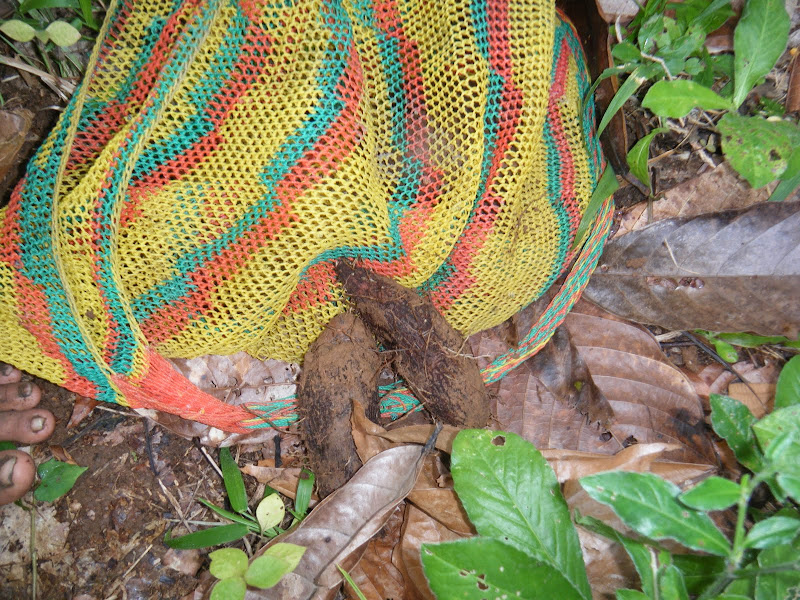
Digging up some root vegetables before heading home.
 |
| From 2011-01-12 |
 |
| From 2011-01-12 |
Monday, January 10, 2011
Birthday
My uncle Peter asked me what it´s like, being here in Panama. It sounds like an easy enough question, and at the time I think I answered with little hesitation. You can get used to anything. Life in the village feels normal to me now. Things that shock outsiders seem so minor to me that sometimes I wonder why they make such a big deal out of them. I uess i can't say exactly what it's lie being here because I've gotten so used to it.
While I was home, a lot of people asked me if the kids in my village get presents at Christmas. They don´t. If families celebrate, it might be with a nicer-than-normal meal. They spend a few extra dollars to have stewed chicken and maybe a bit of lettuce and tomato.
This idea seemed to make Americans sad. A Christmas without presents. But that´s only because we´ve always had something to open on Christmas morning. We´d miss all that stuff if we only had a plate of chicken to look forward to. But poor kids don´t believe in Santa. They don´t expect presents, so it´s not really sad when there aren´t any. That is just how Christmas is here. They eat well, spend the day with the family, and are truly grateful if the day goes by and everyone is healthy, happy and full. Sounds nicer than some American Christmases if you ask me.
Birthdays are the same. Special food if there´s money, and if not, it´s just another day. I got used to that. But returning to my community after spending two weeks in the states, and at a time when it´s buy buy buy, give give give, my view was set a little askew.
One of my favorites, Rosibel turned five on Friday. The day before her mother has been rushed to the hospital after fainting while washing clothes. Rosibel came over to my house early on Friday morning when Julio, her dad, stopped by to tell me he was going to the hospital for the day to be with his wife, and his oldest daughter would be watching the younger kids. I asked Julio if Rosibel knew it was her birthday. I thought maybe they hadn't said anything, since no one would be there to celebrate with her. Family emergencies take precedent. But he said that yes, she knew.
In the mixed-up mash of having one foot still in the U.S. and one in my village, I lost my balance a little bit. All of a sudden I wanted to give this girl a birthday. Maybe because her family made me a part of theirs in the last year, or because she is one of the sweetest, most adorable children around and expected nothing. And in a weird way, I think I wanted to do it mostly for me. When I returned to QP after being in the states, a heaviness landed on my chest. I wanted something fun for these people, something to be easy, to celebrate something. After almost a year and a half there I got used to the hardships and the rough edges, but I felt newly exposed once I came back.
So the mission that day was to lighten the mood. I made Rosibel a birthday crown. I gave her some change, a fortune to a five-year-old. And I let her in every single time she came by the house (at least five or six.) When I saw her running to the hill each time a bus slowed to see if her parents were finally coming, I offered to read her a story instead.
I don´t think I would have felt as sympathetic had I not just returned from the states. If you let every sad or difficult thing affect you here, you would be immobile. But somehow, after reminding myself how easy things can be at home compared to life here, I felt the need to make something easy just for once. Brighten a birthday just for the sake of it.
You can get used to anything, including forgotten birthdays and holidays. In the big scheme of things, they are trivial. But sometimes all it takes is a birthday crown and a smile to turn a couple of girls' day around.
(she insisted on posing with the pencil sharpeners)
While I was home, a lot of people asked me if the kids in my village get presents at Christmas. They don´t. If families celebrate, it might be with a nicer-than-normal meal. They spend a few extra dollars to have stewed chicken and maybe a bit of lettuce and tomato.
This idea seemed to make Americans sad. A Christmas without presents. But that´s only because we´ve always had something to open on Christmas morning. We´d miss all that stuff if we only had a plate of chicken to look forward to. But poor kids don´t believe in Santa. They don´t expect presents, so it´s not really sad when there aren´t any. That is just how Christmas is here. They eat well, spend the day with the family, and are truly grateful if the day goes by and everyone is healthy, happy and full. Sounds nicer than some American Christmases if you ask me.
Birthdays are the same. Special food if there´s money, and if not, it´s just another day. I got used to that. But returning to my community after spending two weeks in the states, and at a time when it´s buy buy buy, give give give, my view was set a little askew.
One of my favorites, Rosibel turned five on Friday. The day before her mother has been rushed to the hospital after fainting while washing clothes. Rosibel came over to my house early on Friday morning when Julio, her dad, stopped by to tell me he was going to the hospital for the day to be with his wife, and his oldest daughter would be watching the younger kids. I asked Julio if Rosibel knew it was her birthday. I thought maybe they hadn't said anything, since no one would be there to celebrate with her. Family emergencies take precedent. But he said that yes, she knew.
In the mixed-up mash of having one foot still in the U.S. and one in my village, I lost my balance a little bit. All of a sudden I wanted to give this girl a birthday. Maybe because her family made me a part of theirs in the last year, or because she is one of the sweetest, most adorable children around and expected nothing. And in a weird way, I think I wanted to do it mostly for me. When I returned to QP after being in the states, a heaviness landed on my chest. I wanted something fun for these people, something to be easy, to celebrate something. After almost a year and a half there I got used to the hardships and the rough edges, but I felt newly exposed once I came back.
So the mission that day was to lighten the mood. I made Rosibel a birthday crown. I gave her some change, a fortune to a five-year-old. And I let her in every single time she came by the house (at least five or six.) When I saw her running to the hill each time a bus slowed to see if her parents were finally coming, I offered to read her a story instead.
I don´t think I would have felt as sympathetic had I not just returned from the states. If you let every sad or difficult thing affect you here, you would be immobile. But somehow, after reminding myself how easy things can be at home compared to life here, I felt the need to make something easy just for once. Brighten a birthday just for the sake of it.
You can get used to anything, including forgotten birthdays and holidays. In the big scheme of things, they are trivial. But sometimes all it takes is a birthday crown and a smile to turn a couple of girls' day around.
 |
| From 2011-01-12 |
(she insisted on posing with the pencil sharpeners)
Monday, December 6, 2010
Introducing...
My piglet. I purchased him for $25, and he will meet his maker next October for my despidida, or goodbye party, at the end of my service. There aren´t many opportunities in the United States to do these kinds of things, so I took advantage, although it did make my heart cringe a little. For this reason, he is living out of my site, at my neighbor´s parents´ house, so I won´t be confronted with my meat-eating savagery on a daily basis.

When the banana truck passed by, I bought him all this food for $2.50!

Oink Oink!
To Plant Corn
The 21st of November was a full moon, an important day for most farmers. Wood is cut on the full moon to avoid insect infestations. Most crops are planted to ensure a better harvest. That day, I accepted the invitation of my neighbor Hernando to plant corn in his finca.
It is the custom that food is provided on work days by the family for whom the work is being done. So after a hearty breakfast of coffee, boiled plantains, and hot dogs, we headed out of the house in a light mist. Forty minutes later, we arrived at the parcel of land he had burned earlier in the week to prepare for planting. Sticks were cut to make holes for the kernels, and we got started.
That day we had to abide by the rules of a superstition. It dictates that because Hernando´s wife is pregnant, we could not bring any food or water to the finca, or the corn would not grow. The people here have a lot of beliefs, and many make some sense, but this is one of the stranger ones I´ve heard. Apparently this food and drink rule only applies to rice and corn because they are more ¨delicate¨ crops. One wonders how the corn would know if I brought a bottle of water, or that his wife is pregnant, or what espiritu malo, bad spirit, would bother presiding over such a specific circumstance. Nevertheless, I abided by the rule because I don´t need the guilt of a failed corn harvest on my shoulders. I made a mental note not to plant any more rice or corn with Hernando until his wife has the baby. A hotter day could result in some serious dehydration.
In four hours. the five of us planted the whole parcel. Just as we finished, the rain started to pour, and we slid down back to his house to enjoy another meal-- stewed fish and plantains. Hernando stopped by a couple of days ago to report that the corn had sprouted nicely. He attributed this to the restraint we showed with regard to staying hydrated, and the good graces of the spirits.
The view from the ridge:


On our way down, we passed one of my favorites, Marvin who had been sent down to get some groceries.
Sunday, May 2, 2010
The Ngobe Cookbook Part Two
Many of you reacted with more horror than I was expecting the first time I shared some of the Ngobes´ favorite recipes. I just get used to things and I forget that maybe other people wouldn´t like to be served a bowl of boiled yucca with rice, boiled bananas, and noodles on top. Why? Because not everyone likes to eat three days worth of carbs in one sitting. Oh, I forgot.
I bring you this second edition, because lately my neighbors have been offering me a whole heck of a lot of food. I am not sure why this started up again, but I sort of wish it would stop, because as much as I appreciate their generosity in sharing what little they have, I know their own families need and enjoy it more.
THE BAD
Patitas-Chicken feet. If a family has chicken to eat, they´re doing pretty well. It means that day they had the money to buy something other than canned sardines or just eat the root vegetables in their finca. However, we must never forget that this is Panama and these people are poor, so the chicken they eat is of a different variety than what you or I might choose at home. Chicken feet cost 65 cents a pound, and when used to made a soup, they really do provide a nice, rich, chickeny flavor. But don´t rush out to your butcher just yet.
Because when it comes to actually eating the feet? That part is not fun. The texture of the dimply skin is fatty and rough, and if you get a mouthful of anything, it´s tendon or bone. No problem for the Ngobes, because they like to eat the bones, and good thing because I am quite sure that fish and chicken bones are their only true source of calcium.
Pescuezo- Chicken necks! An economic step up from the feet. These cost about 85 cents a pound, and on the back, they do have a little strip of meat. The rest of it, like the feet, is skin, tendon and vertabrae. Chicken necks have good flavor too, in theory, but would be better if just used for stock and removed. I always have to floss pieces of spine and marrow out of my teeth after eating these. Not pretty.
I always feel guilty when offered these two foods, because the Ngobes eat every last little bit, but I still can´t bring myself to chomp down with gusto on chicken spine. For them any kind of chicken is a special occasion, a good day. It reminds me how lucky I am that I have never been hungry enough to eat chicken bones, or to suck a chicken toe of the foot and nearly swallow it whole. I worry that I am showing them disrespect when I leave so much of what to them is good food left in my bowl. I do my best to eat as much as possible, but there are some habits a gringa just can´t break.
Chica de Maiz- Corn juice. Grind uncooked corn kernels, throw them in a big pot with water and cook until you have a thick, milky consistency. Add sugar if, Gracias a Dios (Thank God), you have some that day. The result is a slightly sour, rock heavy beverage that is served hot. It tastes like something that will make you really sick later on. It hasn´t actually yet made me ill, but if my neighbor offers me some at 8am, I am not hungry again til dinner. Sticks to your ribs.
THE AMAZING
Cacao- I live in chocolate country. It grows on trees. I buy it for 30 or 35 cents a ball, depending on my dealer. I say dealer because I am addicted. A ball yields probably between 8 or 10 servings. Grate into water, let it come to a boil, and steam for 10-15 minutes, add sugar. For super rich hot chocolate, do it with powdered milk, and allow yourself to experience the most incredible beverage on the planet. Also delicious served when left to cool in the pot. Chocolate milk!
Fried plantains- Oh my God. Slice super ripe plaintains. Fry in oil. My Ngobes don´t make these very much, they say maduros (ripe bananas or plantains) give them diarrhea. I think it is the idea that it has a flavor that is upsetting to them. But that´s fine, more for me. Can´t wait to make these back in the states and serve over ice cream. You gringos are going to freak out.
Arroz con Coco- Rice cooked with juice from inside a coconut (maybe 1/2 or 2/3 coconut, to 1/2 or 1/3 water). A carribean favorite and INCREDIBLE when served with fried fish. Thank God coconuts grow everywhere.
Subscribe to:
Posts (Atom)
