Many of the most memorable conversations I´ve had with people in my site are about health and home remedies. People here rely on botanical medicine and some of the local healers have extensive knowledge of the local plants that cure a wide range of ailments. What they know is impressive and to be respected. The only objection I raise to the use of natural medicines is in serious cases, when a person fails to get better, or needs urgent care, and the family inevitably waits too long to take the person to a doctor. Some of the medicine men´s remedies are guesses, and they have no ¨real¨ training beyond tradition. There are limits to what they do, although the people I live with will be just as quick to remind you that the same is true of doctors.
As a volunteer, it´s important for me to walk the line of acceptance and support for local knowledge, while also offering some ideas and tips from a more modern, clinical perspective.
During my time here, I´ve learned a lot about the basic beliefs and superstitions of the people in my area. Here are a few of the most common :
1. For parasites, diarrhea, stomach ache, etc., follow the following recipe:
Boil very stong coffee in only a few ounces of water. Add the juice of one lemon and dissolve an Alka Seltzer tablet. Drink it all and expect relief within a few hours.
Note: People swear by this. I doubt what value it could possibly have, but it certainly sounds like something that would flush out the pipes.
2. Skin infections. When I was having a lot of problems with infections of my legs and feet, people were always asking who I had been hanging around with. This question made little sense to me, until they explained that the sort of infections I was getting are usually contracted when the afflicted person spends time near a pregnant woman. They say that the ¨heat of her belly¨ causes the outbreak. Don´t worry though. There is a simple cure. Go to the woman´s house and ask her for a glass of water. Drink it all and the infection will go away. But it is important that you drink her water, or else it won´t work.
They are aware that this sounds a little fanciful, so they usually say, ¨I know it seems like a lie, Cati, but it´s true.¨
3. People believe very much in curses, and for people who are chronically ill and don´t get better, or who visit a doctor who cannot render a diagnosis, it is assumed that they have been cursed. The doctor can´t see the disease because it is only the manifestation someone´s ill wishes against them. For this reason, people often don´t take medicine given to them if they believe the root cause of the illness is really a maldicción. (Medical compliance is a whole other issue, which could be a post in itself.)
4. Relationships of hot and cold are extremely important and can explain away the onset of virtually any sickness. For example, one must never bathe right after working, because the cold water combined with a hot, sweaty body is a recipe for disaster. You should also only drink hot drinks when it´cold because that is the only time your body can truly handle them. I have offended more than a few visitors by offering hot coffee on a warm day.
I once baked using my neighbor´s stove, and she came in and told me not to bother washing the dirty dishes. She mentioned how I would get sick if I washed them, because I had been so close to the hot oven and taking pans in and out all afternoon. I thought this was her way of telling me she didn´t mind cleaning up my mess, but I washed the dishes anyway. I received a very angry scolding afterwards, and she checked up on me for days afterward to see if I was okay.
5. Worms (of the intestinal variety) are so normal that people believe they are necessary to digest food. When I talk about eliminating contaminants from drinking water, people have asked, ¨but how can we keep eating if we don´t have worms?¨ I didn´t quite realize how strongly people believe in worms being necessary for sustaining life, until a child asked me if I had worms, and when I said no, both he and his cousin asked in unison how I was still alive.
6. You must never eat pork if you have any kind of medical condition, real or imagined. Any kidney condition will be especially aggravated. (Many have already told me I will have to buy chicken for them when I have my goodbye party, because that pig I have been raising is no good to them.)
7. People usually don´t attribute diarrhea to bad water or unwashed hands. It is almost always caused by fresh fruit, vegetables, bread, or virtually any food that that they don´t eat every day. And you know, this may actually be true because some things are so unfamiliar to them, they may upset stomachs. Nonetheless, this belief is a serious inhibitor to good nutrition.
It´s always a challenge to determine if I should offer counter information and when to do it. Even though these things sound ridiculous to us, I am conscious of the fact that me explaining ideas like solar disinfection of water sounds just as preposterous to them. The invisible rays of the sun are killing the invisible microbes in the water? Sure, Cati. How can I convince them that their baby really shouldn´t pick things up off the floor and put them in her mouth when babies have always done that, and most of them grow up to be healthy, functional adults?
When I first came to my community, I was shocked at what I perceived as a blatant disregard for basic cleanliness. What I now realize is that people are very conscious of cleanliness and their family´s health, but their reasons for preventing or explaining illness are very different, and unfortuantely, in many cases, misdirected. They take great care sweeping out their houses, bathing their children, and generally making sure their homes look as neat and tidy as possible. They are doing what they think is best to be clean and healthy. Every mother loves her child and wants him to be well. She does everything with his best interests in mind. This is a universal human trait. If she fall short, it is almost always due to a lack of education or simply traditional beliefs that offer different explanations.
A friend recently explained it this way, and it makes total sense: Very few of us Americans have ever actually seen a germ. By this I mean, to have looked through a microscope and seen a cold virus, bacteria or anything else that causes disease. But we believe it because we have years of education and resources that tell us that it´s so, and we accept it as fact. We have had access to scientific information and education, and that is what informs our thinking and behavior. For people who haven´t had that access, there are other explanations and reasons for things that seem as plausible to them as a cold virus does to us.
Thinking of it that way, how can we look down on someone who has a lifetime of experience that indicates to them bathing right after work might cause the flu? It seems irrational to an American, but we sound equally so to them when we explain that there are harmful things in their water that looks perfectly clean to them.
Part of my job has been to touch on that common desire we all have to be healthy and offer some new ideas and strategies to be even healthier. And sure, I´ll drink that pregnant lady´s glass of water to clear up my foot infection, if she meets me halfway and puts bleach in it first.
Saturday, July 30, 2011

Saturday, July 16, 2011
Book Report
A blog chronicling Peace Corps life would be incomplete without some acknowledgment of how much we read. Even on my busiest days, I spend an average of three hours reading. And then of course, there are the rainy days, or the slow days, when the majority of waking hours are spent devouring a book while lounging in the hammock.
I feel spoiled to have so much time to invest in books. I was a reader in the United States, but I have read probably 70 books during my service which is certainly the greatest number I've gone through in a two-year period since I graduated from story books. (And somehow, that 70 is on the low end of many PCV counts...) This daily reading binge will soon come to an end, when I go back home and am distracted by the Internet, smart phones, electricity, and actual 9-5 occupations. So until then, I will relish my nightly routine of making a strong cup of Panamanian coffee, lighting my kerosene lamp, and settling into the hammock and reading until I'm too tired for another page. Here is a list of my top 10 favorites:
1. The Ghost Map, by Steven Johnson- This is about the cholera epidemic in 19th century England. It traces the outbreak to a single household and explains how it spread rapidly due to a lack of public health infrastructure and scientific knowledge. It chronicles the independent works of a priest and scientist who mapped the outbreak and founded a new framework for understanding diseases and how they are spread. It beautifully weaves together ideas of epidemiology, urban planning, public health and the future of cities and their environmental consequences. Completely fascinating.
2. The World According to Garp, by John Irving. I've read several of Irving's books here in Panama, including A Widow for One Year,The Hotel New Hampshire, Last Night on Twisted River, and A Prayer for Owen Meany. He has become one of my favorite writers. I'm addicted to his crafty writing and epic stories that follow the characters from childhood to adulthood. What makes his books so remarkable is how he combines incredible plot elements, ie dwarves, weird fetishes, and circuses, with richly-detailed characters who ring completely true. A great storyteller.
3. How the Brain Changes Itself, by Norman Doidge. A book about brain science which overturns any notions about our minds being "hard-wired" and unchanging. Doidge explains the idea of neuroplasticity through case studies involving stroke patients, or people who suffered injuries or birth defects and then went on to train their brains to function in unexpected and highly effective ways. A nerdy pick, but worth reading if you're interest in medicine or science.
4. Little Bee, by Chris Cleave. I had to put off all work-related activities until I finished this book. One of the most affecting novels I've ever read. The back of the copy I own contains only a sentence or two of plot summary because it claims not to want to ruin the story. I'll say this much: the book is narrated by a young girl from Nigeria and a woman in England. Their lives intersect and what results is an incredibly thoughtful book on what it means to have a conscience, memory, and culture and how these things affect the relationship between people in ways we can only try our best to understand. The plot twists and turns and you'll never know what's about to happen to the characters whose voices will stay with you a long time after you close the back cover. Read this.
5. The Grapes of Wrath, by John Steinbeck. Love Steinbeck. East of Eden might be my favorite book ever, and Grapes of Wrath lived up to all my expectations. Who could ever forget the Joads?
6. The Girl with the Dragon Tattoo triology, by Steig Larsson. Page-turning thrillers that will also making you completely uninterested in pursuing other tasks. The second two installments can't beat the tight, expertly-woven plot of the first book, but the Lisbeth Salander character has to be one of the most interesting in modern popular fiction and you'll want to follow her until the end.
7. The Spirit Catches You When You Fall Down, by Anne Fadiman. An extensively researched look at how Western medicine collides with cultural tradition of the Hmong people from Laos. A toddler named Lia lives with her family in a Hmong community in California and is diagnosed with a seizure disorder. Traditional Hmong culture views this as a misalignment or curse of the spirits. Her parents refer the illness as 'the spirit catches you and you fall down' and believe it is caused by a wandering of the soul. While Lia sees doctors at a local California hospital, her parents are confused by their clinical diagnoses and obvious disregard for the soul's role in Lia's healing. Their efforts to incorporate natural remedies into Lia's treatment results in accusations of non-compliance and eventually they are declared unfit and Lia is taken to a foster family. But this book takes no sides. Fadiman showcases the strengths and limits of Western medicine and Hmong culture equally, and makes it clear that neither one nor the other, but rather the clash of the two, is what ultimately failed Lia. It is a compassionate and dramatic story that will challenge the world view of any reader.
8. The Poisonwood Bible, by Barbara Kingsolver. A story of a fervent missionary who brings his family to the Belgian Congo in the 1959 just before the country's revolution. They are dangerously ill-prepared in every sense and in the course of events, Kingsolver shows what it takes to fracture families and countries. This book is certainly political, but I loved it for the story it told and the sometimes breathtaking beauty of the author's writing.
9. The Professor and the Madman, by Simon Winchester. This non-fiction pick is about the making of the Oxford English Dictionary and its most prolific contributor, who sent in over 10,000 entries while he was a patient at an asylum for the criminally insane. This story proves the maxim that truth is stranger than fiction. Winchester tells it with the skill of a novelist as he ties together a violent murder, the obsessive drive of the dictionary's editor and the boggling coexistence of genius and madness in one man's mind.
10. Me Talk Pretty One Day, by David Sedaris. This man is hilarious. His essays are the perfect cure for in-site blues. He can take any mundane event and transform it into sharp, witty commentary on family dynamics, culture, or the simple absurdity of everyday life. He writes about pretty much any topic, and if you listen to to NPR, you've probably heard him read one of his stories. Listen to him here as he explains the Easter Bunny.
I feel spoiled to have so much time to invest in books. I was a reader in the United States, but I have read probably 70 books during my service which is certainly the greatest number I've gone through in a two-year period since I graduated from story books. (And somehow, that 70 is on the low end of many PCV counts...) This daily reading binge will soon come to an end, when I go back home and am distracted by the Internet, smart phones, electricity, and actual 9-5 occupations. So until then, I will relish my nightly routine of making a strong cup of Panamanian coffee, lighting my kerosene lamp, and settling into the hammock and reading until I'm too tired for another page. Here is a list of my top 10 favorites:
1. The Ghost Map, by Steven Johnson- This is about the cholera epidemic in 19th century England. It traces the outbreak to a single household and explains how it spread rapidly due to a lack of public health infrastructure and scientific knowledge. It chronicles the independent works of a priest and scientist who mapped the outbreak and founded a new framework for understanding diseases and how they are spread. It beautifully weaves together ideas of epidemiology, urban planning, public health and the future of cities and their environmental consequences. Completely fascinating.
2. The World According to Garp, by John Irving. I've read several of Irving's books here in Panama, including A Widow for One Year,The Hotel New Hampshire, Last Night on Twisted River, and A Prayer for Owen Meany. He has become one of my favorite writers. I'm addicted to his crafty writing and epic stories that follow the characters from childhood to adulthood. What makes his books so remarkable is how he combines incredible plot elements, ie dwarves, weird fetishes, and circuses, with richly-detailed characters who ring completely true. A great storyteller.
3. How the Brain Changes Itself, by Norman Doidge. A book about brain science which overturns any notions about our minds being "hard-wired" and unchanging. Doidge explains the idea of neuroplasticity through case studies involving stroke patients, or people who suffered injuries or birth defects and then went on to train their brains to function in unexpected and highly effective ways. A nerdy pick, but worth reading if you're interest in medicine or science.
4. Little Bee, by Chris Cleave. I had to put off all work-related activities until I finished this book. One of the most affecting novels I've ever read. The back of the copy I own contains only a sentence or two of plot summary because it claims not to want to ruin the story. I'll say this much: the book is narrated by a young girl from Nigeria and a woman in England. Their lives intersect and what results is an incredibly thoughtful book on what it means to have a conscience, memory, and culture and how these things affect the relationship between people in ways we can only try our best to understand. The plot twists and turns and you'll never know what's about to happen to the characters whose voices will stay with you a long time after you close the back cover. Read this.
5. The Grapes of Wrath, by John Steinbeck. Love Steinbeck. East of Eden might be my favorite book ever, and Grapes of Wrath lived up to all my expectations. Who could ever forget the Joads?
6. The Girl with the Dragon Tattoo triology, by Steig Larsson. Page-turning thrillers that will also making you completely uninterested in pursuing other tasks. The second two installments can't beat the tight, expertly-woven plot of the first book, but the Lisbeth Salander character has to be one of the most interesting in modern popular fiction and you'll want to follow her until the end.
7. The Spirit Catches You When You Fall Down, by Anne Fadiman. An extensively researched look at how Western medicine collides with cultural tradition of the Hmong people from Laos. A toddler named Lia lives with her family in a Hmong community in California and is diagnosed with a seizure disorder. Traditional Hmong culture views this as a misalignment or curse of the spirits. Her parents refer the illness as 'the spirit catches you and you fall down' and believe it is caused by a wandering of the soul. While Lia sees doctors at a local California hospital, her parents are confused by their clinical diagnoses and obvious disregard for the soul's role in Lia's healing. Their efforts to incorporate natural remedies into Lia's treatment results in accusations of non-compliance and eventually they are declared unfit and Lia is taken to a foster family. But this book takes no sides. Fadiman showcases the strengths and limits of Western medicine and Hmong culture equally, and makes it clear that neither one nor the other, but rather the clash of the two, is what ultimately failed Lia. It is a compassionate and dramatic story that will challenge the world view of any reader.
8. The Poisonwood Bible, by Barbara Kingsolver. A story of a fervent missionary who brings his family to the Belgian Congo in the 1959 just before the country's revolution. They are dangerously ill-prepared in every sense and in the course of events, Kingsolver shows what it takes to fracture families and countries. This book is certainly political, but I loved it for the story it told and the sometimes breathtaking beauty of the author's writing.
9. The Professor and the Madman, by Simon Winchester. This non-fiction pick is about the making of the Oxford English Dictionary and its most prolific contributor, who sent in over 10,000 entries while he was a patient at an asylum for the criminally insane. This story proves the maxim that truth is stranger than fiction. Winchester tells it with the skill of a novelist as he ties together a violent murder, the obsessive drive of the dictionary's editor and the boggling coexistence of genius and madness in one man's mind.
10. Me Talk Pretty One Day, by David Sedaris. This man is hilarious. His essays are the perfect cure for in-site blues. He can take any mundane event and transform it into sharp, witty commentary on family dynamics, culture, or the simple absurdity of everyday life. He writes about pretty much any topic, and if you listen to to NPR, you've probably heard him read one of his stories. Listen to him here as he explains the Easter Bunny.
Congratulations
...to my brother James on receiving his doctorate. Wish I could be there to celebrate with you, but I did the next best thing: told Nelson to dance. The sign says "Felicitaciones, James!" We send hugs from QP!! And rockin' dance moves.
Sunday, June 19, 2011
Water
PCV Michelle recently finished a huge water project that included many houses in her community, and several others in three other towns. Quebrada Pastor was lucky enough to receive three 300-galllon rainwater tanks bought with funds from her project. A few months ago, when Michelle offered the materials to me, she asked if I had some families in mind. It worked out that there were three in particular who had spoken to me many times about their struggles with water and wanted to figure out what we could do. They all lived far out of reach of the community´s aqueduct, and two of them drank out of a contaminated spring in which they also bathed and washed clothes. Worm infections were common among the families, and on more than one occasion, they had found a dead animal upstream from where they collected water. The third family lived in another remote part of town, and the spring they used often dried up in the summer. The family often packed up and stayed at their grandmother´s house because there was no other source of water nearby.
Michelle came by last week to help with the tank installations. You can read about her project here. Many thanks to her and the project´s donors for providing an essential resource to three families in QP.


Michelle came by last week to help with the tank installations. You can read about her project here. Many thanks to her and the project´s donors for providing an essential resource to three families in QP.
Latrine project continues
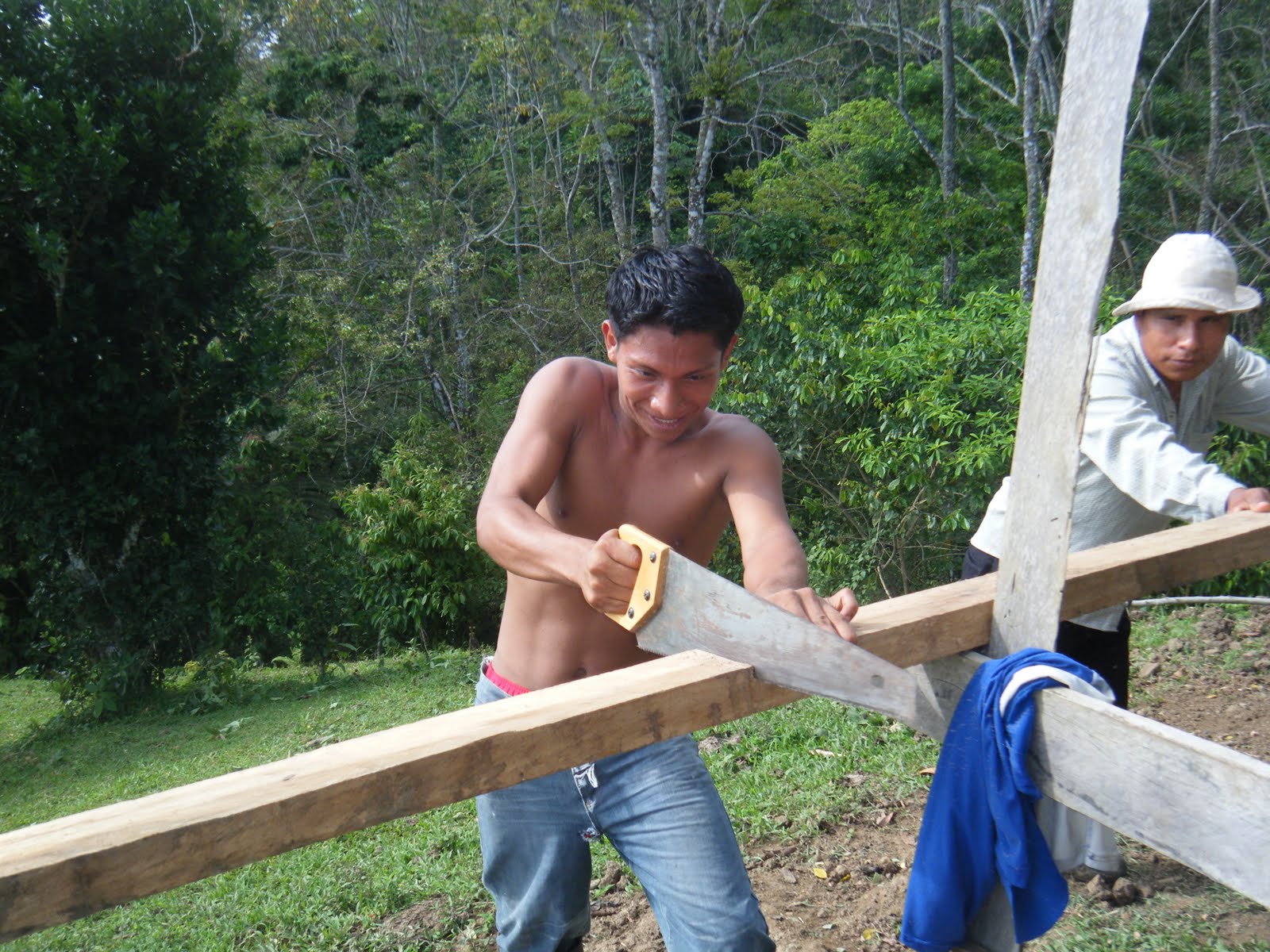
We have reached the downhill slope with regards to the latrine project. We only have about 3 composters and 7 pit latrines to go. It has been a professionally and physically challenging time for me, but it has been the most rewarding part of my service so far watching men transform from not wanting to pick up tools they didn't know the name for, to being able to carry out most of the construction by themselves. And after spending so much time working so closely, my relationship with the workers has become much closer. Work days are filled with jokes, laughs, and openly expressed anxieties about what they will do with themselves when I leave. I feel happy about what they have been able to accomplish and learn throughout the process about initiative, responsibility, and the realities of executing a project like this. Here are some photos of what we´ve been up to.






The Sleepover
My host family, including a 12-year-old brother and 9 and 7-year old cousins, never quite understood why I could live alone. And why I would possibly request to have an entire big house to myself, especially when before I moved in, they used to stay there during the week because it eliminated a 30-minute walk and river crossing on their way to school. It seems ridiculous that I would want to be there alone, night after night, among the witches and goblins that lurk nearby, and in my typical gringa selfishness, had never even once thought to invite them over to spend the night.
So, I finally caved. In my final months, I am relaxing the iron fist with which I have traditionally ruled and letting people, especially the kids, get away with a little more than before. Last week, after my host-brother Kaicer asked me WHEN CAN HE EVER COME AND SPEND THE NIGHT WITH ME, I responded, ''How about Sunday?'' A look of grateful disbelief spread across his face, and I could tell he was thinking, that´s all? All I had to do was ask? I invited him and his cousin, Marvin, and told them to bring their uniforms ironed and ready so they could leave straight for school on Monday morning. He skipped out of my house with a smile plastered to his face, but stopped at the gate to ask, ''What will we eat?''
Feeling particularly generous, the words, ''What do you want?'' tumbled forth, and I immediately regretted it, thinking I would have to go find fish or buy some type of meat that I usually wouldn't prepare. Instead, he said hopefully, ''Rice and a boiled egg?''
DONE. I can do that. ''And for breakfast?''
''Coffee and bread?'' I thought these might by far be the easist house guests I had ever entertained.
So about 5:30 Sunday afternoon the boys arrived with backpacks filled to the brim with books and clothes, and Marvin's little brother, Geovani tagged along. It immediately occurred to me I should have planned something to do in the hours that stretched before us until bed time, but we quickly settled into some easy conversation and Farkle playing. Dinner time came and I busied myself in the kitchen while the boys played outside and started making jokes about how such a white girl could have such three dark-skinned sons. I presented them with their meals, and shortly after, had to get up to boil some yucca because it became obvious that little Geovany is a man of root vegetables and bananas, and did not appreciate my attempts with store-bought rice.
By that time, the neighbor girls had come over and asked if we would be ''doing exercise,'' which is their way of requesting that we do yoga. (I made the mistake of indulging their interest in my yoga magazines a few weeks ago, and am now hounded by daily requests from my little yogis.) Within two minutes, all of the other neighbors had arrived, and I was leading about nine children through a few basic moves. The boys wobbled and giggled, asking ''CATI HOW ARE YOU DOING THIS?!'' as I instructed them to stretch out and reach their hands to the sky in triangle. It was one of the many moments I've had in my service, where I all of a sudden zoom out of the moment, and see what I am actually doing and can hardly contain my laughter. In the Peace Corps you can do anything, including becoming an amateur yoga instructor.
After we took our last vinyasa, I shooed away the riff-raff and offered the boys some hot chocolate, hoping to signal an end to the evening. All of the liquid nourishment I had offered throughout the evening was clearly overwhelming to little Geovany, who stood up to pee through my fence at least half a dozen times. We played cards for a little while, and made sure everyone's uniforms were hung up, and then I tried to get everyone upstairs and settled . They fell asleep right away, and I considered that they settled down a lot easier than most sugar-high-riding American children who stay up half the night, sending pangs of regret and rage through the parents who agreed to host them.
Morning came, and I woke everyone up and went downstairs to put the coffee on. The boys' giddiness from the night before was undiminished as they were visibly reveling in the idea of being in Catí's house and Cati making breakfast for them. Coffee was served with the bread, the boys dressed and scampered off to to school.
A sigh of relief. That was way easier than I thought. Everyone ate, no one complained, fun was had, very little chaos. Until I went up to clean up the blankets where the boys slept, and encountered a sopping, urine-soaked blanket and sleeping pad, which indicated to me that next time, if there is a next time, it is better to err on the side of mild dehydration when it comes to tending to your little guests. Oh well, nothing a little laundry soap and a mild bleach solution can´t fix.


Above: Kaicer, on his 12th birthday in May. Below: Geovany, 7 going on 79
So, I finally caved. In my final months, I am relaxing the iron fist with which I have traditionally ruled and letting people, especially the kids, get away with a little more than before. Last week, after my host-brother Kaicer asked me WHEN CAN HE EVER COME AND SPEND THE NIGHT WITH ME, I responded, ''How about Sunday?'' A look of grateful disbelief spread across his face, and I could tell he was thinking, that´s all? All I had to do was ask? I invited him and his cousin, Marvin, and told them to bring their uniforms ironed and ready so they could leave straight for school on Monday morning. He skipped out of my house with a smile plastered to his face, but stopped at the gate to ask, ''What will we eat?''
Feeling particularly generous, the words, ''What do you want?'' tumbled forth, and I immediately regretted it, thinking I would have to go find fish or buy some type of meat that I usually wouldn't prepare. Instead, he said hopefully, ''Rice and a boiled egg?''
DONE. I can do that. ''And for breakfast?''
''Coffee and bread?'' I thought these might by far be the easist house guests I had ever entertained.
So about 5:30 Sunday afternoon the boys arrived with backpacks filled to the brim with books and clothes, and Marvin's little brother, Geovani tagged along. It immediately occurred to me I should have planned something to do in the hours that stretched before us until bed time, but we quickly settled into some easy conversation and Farkle playing. Dinner time came and I busied myself in the kitchen while the boys played outside and started making jokes about how such a white girl could have such three dark-skinned sons. I presented them with their meals, and shortly after, had to get up to boil some yucca because it became obvious that little Geovany is a man of root vegetables and bananas, and did not appreciate my attempts with store-bought rice.
By that time, the neighbor girls had come over and asked if we would be ''doing exercise,'' which is their way of requesting that we do yoga. (I made the mistake of indulging their interest in my yoga magazines a few weeks ago, and am now hounded by daily requests from my little yogis.) Within two minutes, all of the other neighbors had arrived, and I was leading about nine children through a few basic moves. The boys wobbled and giggled, asking ''CATI HOW ARE YOU DOING THIS?!'' as I instructed them to stretch out and reach their hands to the sky in triangle. It was one of the many moments I've had in my service, where I all of a sudden zoom out of the moment, and see what I am actually doing and can hardly contain my laughter. In the Peace Corps you can do anything, including becoming an amateur yoga instructor.
After we took our last vinyasa, I shooed away the riff-raff and offered the boys some hot chocolate, hoping to signal an end to the evening. All of the liquid nourishment I had offered throughout the evening was clearly overwhelming to little Geovany, who stood up to pee through my fence at least half a dozen times. We played cards for a little while, and made sure everyone's uniforms were hung up, and then I tried to get everyone upstairs and settled . They fell asleep right away, and I considered that they settled down a lot easier than most sugar-high-riding American children who stay up half the night, sending pangs of regret and rage through the parents who agreed to host them.
Morning came, and I woke everyone up and went downstairs to put the coffee on. The boys' giddiness from the night before was undiminished as they were visibly reveling in the idea of being in Catí's house and Cati making breakfast for them. Coffee was served with the bread, the boys dressed and scampered off to to school.
A sigh of relief. That was way easier than I thought. Everyone ate, no one complained, fun was had, very little chaos. Until I went up to clean up the blankets where the boys slept, and encountered a sopping, urine-soaked blanket and sleeping pad, which indicated to me that next time, if there is a next time, it is better to err on the side of mild dehydration when it comes to tending to your little guests. Oh well, nothing a little laundry soap and a mild bleach solution can´t fix.
Above: Kaicer, on his 12th birthday in May. Below: Geovany, 7 going on 79
When they´re not in school...
I make my neighbors participate in American history re-enactments. On this day´s schedule: The Oregon trail! Westward expansion! Sod houses and fur trapping!

Just kidding. These are church dresses their dad made for them. But they look about as thrilled to have them on as they would be to be clearing wagon trails during a winter storm.
Subscribe to:
Posts (Atom)

